The historic Pedamentina staircase descends through the hills of Naples, offering breathtaking panoramic views of the city and Mount Vesuvius.
Most visitors experience Naples from above by taking the funicular to the hilltop fortress of Castel Sant’Elmo. But there is a far more authentic way to discover the city: walking down the legendary Pedamentina a San Martino.
Hidden behind monastery walls and quiet gardens, this iconic stairway descends from the peaceful heights of Vomero into the chaotic soul of Naples itself. Along the way, you pass ancient terraces, hidden vegetable gardens, old defensive walls, and some of the most breath-taking vantage points in the city.
For travelers searching for the secret stairs of Naples, this is not just a walk — it is a journey through centuries of Neapolitan history.
What is Pedamentina a San Martino Famous For?
The famous Pedamentina a San Martino offers one of the most spectacular panoramic views of Naples, the Bay of Naples, and Mount Vesuvius.
Pedamentina a San Martino is an ancient 14th-century stone staircase in Naples that connects the hilltop Vomero district with the historic center. It is famous for offering some of the most spectacular panoramic views of Mount Vesuvius, the Bay of Naples, and the rooftops of the historic city below.
Originally built as a strategic route linking Castel Sant’Elmo and Certosa di San Martino with the lower city, the staircase has become one of Naples’ most iconic hidden walks. Today, travelers use the Pedamentina to experience a quieter, more authentic side of Naples away from the crowded tourist streets.
What is the Pedamentina? A Historical Descent
The Pedamentina a San Martino was built in the 14th century during the Angevin period, shortly after the construction of the Certosa di San Martino and Castel Sant’Elmo. At the time, the staircase served as a critical connection between the hilltop monastery and the crowded lower city below.
Long before funiculars and modern roads existed, this stairway was one of the main arteries linking Vomero to the historic center. Monks, workers, soldiers, farmers, and ordinary citizens used these steps every day to move between the fortress above and the bustling neighborhoods below.
The word “Pedamentina” itself comes from the Neapolitan dialect and roughly refers to a descending stair path.
Today, the staircase feels almost frozen in time. While millions of tourists crowd Naples’ famous streets below, relatively few travelers discover this ancient route. That hidden quality is exactly what makes it so magical.
Walking the Pedamentina feels like uncovering a secret layer of Naples that still belongs to locals.
Why You Should Walk the Pedamentina
The View
A breathtaking panoramic view from Pedamentina a San Martino, featuring Naples’ historic center, the Bay of Naples, and Mount Vesuvius in the distance.
The panoramic scenery is easily one of the greatest reasons to experience the Pedamentina stairs in Naples.
From various points along the descent, the city opens beneath you like a living postcard. You can see the Bay of Naples, Mount Vesuvius, church domes, terracotta rooftops, and even the distant curve of the coastline on clear days.
Unlike crowded observation decks, the Pedamentina offers constantly changing perspectives. Every few turns reveal another incredible vantage point.
This is one of the best panoramic walks in Naples.
The Contrast
The ancient Pedamentina a San Martino staircase winds down from the Vomero hill toward the historic center of Naples, offering a unique perspective of the city.
Few places capture the dual personality of Naples better than this route.
At the top, Vomero feels calm, elegant, and almost detached from the intensity below. The streets are quieter, the air cooler, and the atmosphere relaxed.
But step by step, the city transforms around you.
As you descend toward Montesanto and Spaccanapoli, the silence gives way to scooters, hanging laundry, market voices, church bells, and the raw energy that defines Naples.
The walk from Castel Sant’Elmo to Spaccanapoli becomes more than a route — it becomes a transition between two completely different worlds.
Gardens and Ancient Walls
A spectacular section of the Pedamentina a San Martino staircase overlooking Naples, the Bay of Naples, and Mount Vesuvius.
One of the most surprising aspects of the Pedamentina is how green it feels.
Along the staircase, you’ll glimpse hidden lemon trees, vegetable gardens, private terraces, old vineyards, and ancient stone walls that most visitors never see.
Some gardens have existed for generations, maintained by families living along the staircase. In certain sections, it almost feels as if the city disappears entirely.
This unusual combination of urban life and secluded greenery gives the walk a unique atmosphere unlike anywhere else in Naples.
A Lesser-Known Story: Escape Routes and Wartime Use
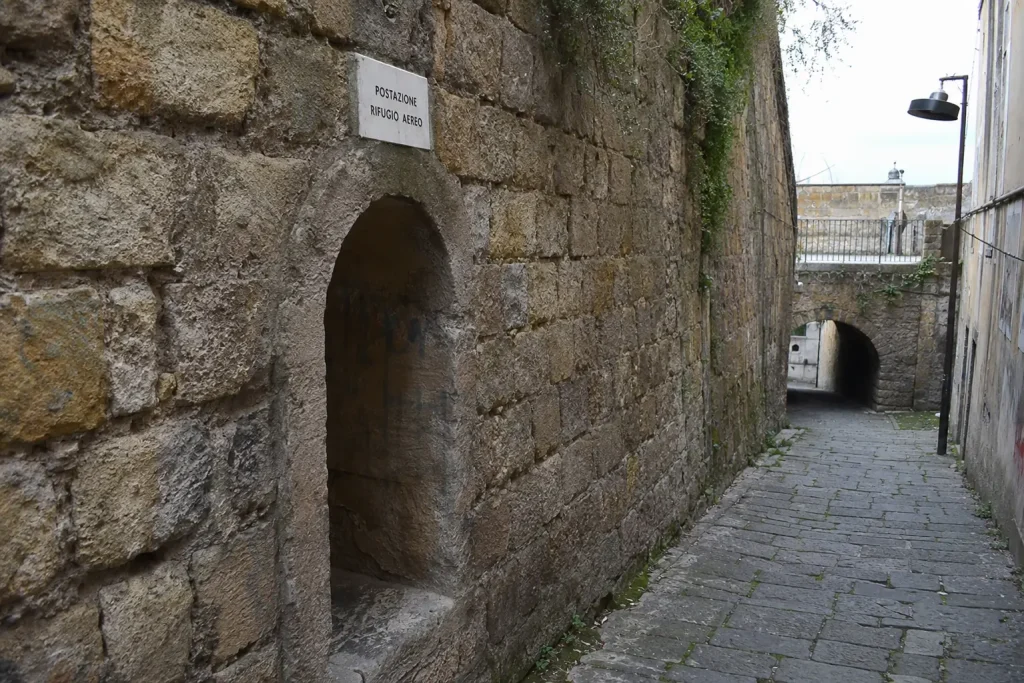
Ancient stone passages along the Pedamentina a San Martino reveal a lesser-known chapter of Naples’ history, when these routes may have served as evacuation and escape paths during wartime.
Because of its strategic connection between the upper hill and lower city, the staircase reportedly played an important role during wartime evacuations and emergency movement during World War II.
Much of this history survives through oral stories passed down by locals, adding another layer of mystery to the route.
Naples has always been a city built vertically — and the Pedamentina was one of the hidden veins that helped keep it alive.
Practical Visitor Guide
The Start: How to Find the Entrance
The entrance to the Pedamentina a San Martino is located near Castel Sant’Elmo and the Certosa di San Martino in the Vomero district.
The easiest way to reach the starting point is:
Take the funicular to Vomero
Walk toward Castel Sant’Elmo
Follow signs or GPS toward “Pedamentina San Martino”
Look for the staircase entrance near the monastery walls
Many visitors accidentally walk past the entrance because it feels hidden from the main tourist streets.
The Route
The staircase gradually descends toward the Montesanto area, not far from Spaccanapoli and the historic center.
Once you reach the bottom, you can continue exploring nearby neighborhoods like Quartieri Spagnoli and the Spanish Quarters.
For a deeper exploration of Naples beyond the tourist routes, continue with our guide:
Hidden Side of Naples: An Insider’s Atlas
Difficulty
The walk is much easier downhill than uphill.
Still, the staircase includes uneven stones, steep sections, and worn surfaces that can become slippery after rain.
Comfortable shoes are strongly recommended.
The full descent usually takes between 30 and 50 minutes depending on stops for photos and viewpoints.
Is Pedamentina Safe?
Many travelers ask: is Pedamentina safe?
During daylight hours, the route is generally considered safe for tourists, especially during late morning and afternoon hours when locals and walkers are present.
However, like many quiet urban stairways, it is better to avoid the route after dark.
Basic city awareness is more than enough for most visitors.
Tips for the Perfect Walk
The sunset from Pedamentina a San Martino transforms Naples into a sea of golden rooftops beneath the silhouette of Mount Vesuvius.
Best Time to Visit
The best time to walk the Pedamentina is during golden hour before sunset.
Warm evening light transforms the rooftops of Naples and creates incredible views of Mount Vesuvius and the Bay of Naples. The entire city begins glowing in shades of orange and gold, making this one of the most iconic photography spots in Naples.
Morning walks are also excellent if you prefer cooler weather and fewer people.
What to Bring
Water: Essential during warmer months. Even descending stairs can become tiring under the southern Italian sun.
Comfortable Sneakers: Avoid sandals or slippery shoes. Some stones are polished smooth from centuries of use.
Camera or Smartphone: You will constantly want photos; the panoramic views are among the most iconic in Naples.
Light Jacket: Evening winds on Vomero hill can sometimes feel surprisingly cool.
Hidden Gems in Naples
Beyond the pizza shops, chaotic traffic, and famous waterfront views, Naples hides ancient underground cities, forgotten Roman theatres, secret tunnels, mysterious churches, hidden palaces, and candlelit passages buried beneath centuries of history. Here are the hidden gems that reveal the city’s most fascinating and authentic side.
The nearby Montesanto district is especially famous for authentic local atmosphere, fresh produce markets, fried street food, espresso bars, and everyday Neapolitan life far from polished tourist zones.
This route creates one of the most authentic Naples experiences possible — from peaceful panoramic terraces to total immersion in the soul of the city below.
FAQ
Is it hard to walk down the Pedamentina?
No. Since the route goes downhill, most visitors find it manageable. However, the steps can be uneven in places, so comfortable footwear is important.
Do I need a ticket?
No. The Pedamentina a San Martino is completely free and open to the public.
Can I walk up instead of down?
Yes, but climbing the staircase uphill can be physically demanding, especially during summer.
How long does the walk take?
Most visitors spend around 30–50 minutes descending depending on how often they stop for photos and viewpoints.
Are there panoramic viewpoints along the way?
Yes. The route contains multiple breath-taking viewpoints overlooking Mount Vesuvius, the Bay of Naples, and the historic center.
Is the Pedamentina crowded?
Usually no. Compared to Naples’ major attractions, the staircase remains surprisingly peaceful and uncrowded.
Can I visit with children?
Yes, although parents should supervise carefully on steeper or slippery sections.