Inside San Miniato al Monte — a mysterious Romanesque basilica overlooking Florence from above the city.
Most tourists end their day at Piazzale Michelangelo without realizing that the “real” Florence waits just a little higher above the crowds. Perched on one of the highest points in the city, San Miniato al Monte — also known in Italian as Basilica di San Miniato al Monte — is far more than just another church. It is one of Florence’s oldest and most beautiful sacred places, watching over the city since the 11th century.
Here, Olivetan monks still live behind ancient walls. Gregorian chants still echo through candlelit halls. And from the terrace outside the basilica, Florence unfolds like a Renaissance painting beneath your feet.
If you want to experience Florence beyond the tourist noise — beyond crowded viewpoints and rushed itineraries — San Miniato al Monte is the place that stays in your memory long after the trip ends. In this guide, you’ll discover how to reach the basilica, when to hear the monks sing, what hidden details most visitors completely miss, and why this hilltop sanctuary may be the most magical place in all of Tuscany.
Why San Miniato al Monte is a Must-Visit
The stunning Romanesque facade of San Miniato al Monte overlooking Florence under bright Tuscan sunlight.
Among all the churches in Florence, San Miniato al Monte feels different. It is quieter, older, more spiritual — and somehow more connected to the soul of the city than many of Florence’s famous landmarks.
For travelers searching for genuine Florence hidden gems, this basilica is one of the city’s ultimate must-visit locations. It combines breathtaking panoramic views, medieval history, monastic traditions, and some of the finest Romanesque architecture in Italy.
The church is widely considered one of the greatest surviving examples of Florentine Romanesque architecture. Long before the marble facade of the Duomo became an icon of Florence, San Miniato church Florence was already defining the city’s architectural identity with elegant geometric patterns of white Carrara and dark green Prato marble.
But architecture alone is not why people fall in love with this place.
What truly makes San Miniato unforgettable is the atmosphere. Unlike many churches transformed into purely tourist attractions, this basilica still feels alive. Monks walk silently through the cloisters. Incense drifts through the air. Bells echo across the hill at sunset. Even visitors who are not religious often describe the experience as deeply emotional.
And then there is the view.
From the terrace outside the church, Florence stretches across the Arno Valley in perfect harmony: the dome of Florence Cathedral, the tower of Palazzo Vecchio, and the Tuscan hills fading into the horizon. Many travelers consider it the best view of Florence — even better than the one from Piazzale Michelangelo below.
The History: A Fortress of Faith
The atmospheric interior of San Miniato al Monte featuring marble columns, medieval mosaics, and one of Florence’s most beautiful Romanesque church interiors.
The history of San Miniato al Monte begins with one of Florence’s oldest legends.
According to tradition, St. Minias (San Miniato in Italian) was an Armenian prince and Christian hermit who lived near Florence during the Roman Empire. Around the 3rd century AD, during the persecutions ordered by Emperor Decius, Miniato was arrested for refusing to renounce Christianity.
Legend says he was publicly beheaded near the Roman amphitheater of Florence.
But the story does not end there.
According to medieval chronicles, after his execution, St. Minias picked up his severed head and walked across the Arno River to the hill where the basilica now stands. He finally collapsed at the exact place chosen centuries later for the church.
Whether literal history or symbolic legend, the story transformed this hill into one of Florence’s holiest places.
Construction of the current basilica began in 1018 under Bishop Alibrando, making San Miniato al Monte one of the oldest surviving churches in Florence. During the Middle Ages, the complex served not only as a spiritual sanctuary, but also as a strategic fortress overlooking the city.
Its elevated position became so important that defensive walls were later strengthened by Michelangelo during the Siege of Florence in 1529–1530. Few visitors realize that the Renaissance genius personally helped fortify the hill against invading forces.
Today, San Miniato remains one of the most historically layered places in Florence — a combination of faith, legend, art, and military history.
Architectural Marvels: What to Look For
Many tourists walk through San Miniato al Monte in less than ten minutes.
That is a mistake.
This basilica is filled with artistic details, hidden symbols, and architectural innovations that most visitors completely overlook.
The Facade: Florence Before the Renaissance
The iconic Romanesque marble facade of San Miniato al Monte, one of Florence’s oldest and most breathtaking churches.
The facade of San Miniato al Monte is one of the purest masterpieces of Romanesque architecture in Italy.
Its geometric symmetry feels almost mathematically perfect. White and green marble create elegant patterns that later inspired Florence’s cathedral and many Tuscan churches.
At the center, visitors will notice a golden mosaic of Christ between the Virgin Mary and St. Minias. Beneath it sits a striking zodiac wheel — a fascinating reminder that medieval churches often blended astronomy, symbolism, and theology together.
One lesser-known detail: the eagle crowning the facade is the symbol of Florence’s powerful Wool Guild, which financed parts of the church during the Middle Ages.
The facade of San Miniato al Monte is often considered a direct architectural predecessor of the famous Duomo facade seen today in Florence.
The Interior: Silence, Marble, and Light
Sunlight pours into the breathtaking Romanesque interior of San Miniato al Monte, illuminating marble columns, geometric patterns, and centuries of Florentine history.
Stepping inside the church feels like entering another era.
Unlike many Italian cathedrals designed to overwhelm visitors with grandeur, San Miniato creates a quieter, more mystical atmosphere. Sunlight filters softly through ancient windows, illuminating the marble floor and dark wooden ceiling.
Look carefully at the floor.
The geometric marble pavement contains zodiac symbols and cosmic imagery rarely preserved so beautifully in medieval churches. Historians believe parts of the design may have been connected to astronomical calculations and sacred calendars.
At the far end of the church, the glowing 13th-century apse mosaic dominates the sanctuary. Christ sits enthroned between the Virgin Mary and St. Minias, surrounded by shimmering gold that catches the late afternoon light dramatically.
Beneath the altar lies the crypt — one of the oldest surviving sections of the basilica. Supported by forest-like columns, it creates an atmosphere closer to an ancient monastery than a crowded tourist attraction.
Hidden Gems in Florence
Beyond the Duomo and crowded piazzas, Florence hides secret pharmacies, forgotten towers, quiet libraries, surreal gardens, and Renaissance mysteries most tourists never see. Here are 11 hidden gems that reveal the city’s true soul.
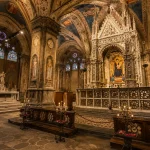
The breathtaking Renaissance interior of the Cappella del Cardinale del Portogallo inside San Miniato al Monte in Florence.
Hidden within the basilica is one of Florence’s overlooked Renaissance treasures: the Cappella del Cardinale del Portogallo (Chapel of the Cardinal of Portugal).
Built during the 15th century, this chapel is considered one of the finest examples of early Renaissance funerary art in Tuscany. Sculpture, frescoes, marble decoration, and painted ceilings come together in extraordinary harmony.
Despite its artistic importance, many tourists walk past the chapel without realizing they are looking at a Renaissance masterpiece.
That is part of San Miniato’s magic: the beauty reveals itself slowly.
The Monastic Experience: Gregorian Chants
The atmospheric crypt beneath San Miniato al Monte, where Gregorian chants echo through ancient stone vaults above Florence.
If possible, plan your visit around the evening Gregorian chants.
This is the moment when San Miniato al Monte transforms from a beautiful church into something unforgettable.
As the light fades over Florence, Olivetan monks gather for prayer and begin singing ancient Gregorian chants that echo through the marble interior of the basilica. The sound is haunting, meditative, and unlike anything most travelers experience elsewhere in Florence.
Even visitors who do not understand Latin often describe the chants as one of the emotional highlights of their trip to Italy.
Gregorian chants at San Miniato are traditionally performed during evening vespers, usually in the late afternoon or early evening. Schedules may occasionally vary depending on the religious calendar, so checking locally before your visit is recommended.
An important detail many visitors forget: silence is expected during services. This remains an active monastery, not merely a historical monument.
(H3) The Monastic Shop
Near the basilica, travelers can also visit the small monastic shop operated by the monks.
Here you will find authentic products made by the monastic community, including:
herbal teas
honey
soaps
candles
herbal remedies
traditional liqueurs
These products continue centuries-old monastic traditions connected to herbal medicine and craftsmanship.
For travelers searching for meaningful souvenirs, the monastic shop offers something far more authentic than typical tourist stores in central Florence.
Visitor Guide: How to Get There & Practical Tips
The breathtaking apse mosaic of San Miniato al Monte illuminated by warm sunlight inside one of Florence’s oldest Romanesque churches.
The Best Way to Reach San Miniato al Monte
Technically, you can reach the basilica by bus, taxi, or car.
But honestly, walking is part of the experience.
The most scenic route begins at Piazzale Michelangelo. From there, continue uphill for approximately 10 minutes along the staircase and road leading directly to the basilica.
Most tourists stop at Piazzale Michelangelo.
Very few continue higher.
And that final climb changes everything.
As you ascend toward San Miniato al Monte, the crowds begin to disappear, the city noise fades away, and Florence slowly opens beneath you with every step.
For those arriving by taxi or car, note that there is a limited parking area nearby, but arriving by foot from Piazzale Michelangelo is highly recommended to fully appreciate the dramatic approach to the church.
The final uphill walk is not just transportation — it is part of the emotional experience of visiting San Miniato al Monte.
Opening Hours & Entrance
San Miniato al Monte is free to enter, although donations are appreciated and help preserve the basilica and support the monastic community.
One important thing to remember: the church itself typically closes before sunset, while the surrounding terrace and viewpoint remain accessible later into the evening.
This means visitors should explore the interior first before waiting outside for sunset views.
Because San Miniato remains an active religious site and important cultural heritage monument, respectful clothing is recommended:
shoulders covered
knees covered
quiet behavior during services
This small detail reinforces the authenticity of the experience — the basilica still functions as a living spiritual place rather than a purely commercial tourist attraction.
Sunset at San Miniato: Beyond Piazzale Michelangelo
A breathtaking sunset view over Florence from San Miniato al Monte, where golden light transforms the city skyline into one of Tuscany’s most unforgettable panoramas.
Most Florence travel guides focus entirely on sunsets at Piazzale Michelangelo.
But locals and experienced travelers often prefer San Miniato al Monte instead.
Why?
Because it offers nearly everything Piazzale Michelangelo does — but with more atmosphere, fewer crowds, and a much deeper emotional connection to Florence.
At Piazzale Michelangelo, visitors stand among hundreds of tourists taking photos and selfies.
At San Miniato, you hear church bells, distant music, evening wind moving through cypress trees, and the quiet sounds of Florence below.
It feels calmer. More timeless. More personal.
As the sun disappears behind the Tuscan hills, Florence slowly changes color — gold, orange, pink, and deep blue. The dome of the Duomo glows against the skyline while shadows fill the medieval streets below.
It is not just one of the best sunset spots in Florence.
It is one of the most unforgettable views in all of Italy.
Hidden Gems in Venice
Venice is more than gondolas and crowded canals. Step away from the tourist routes and discover quiet districts, hidden courtyards, and places where the city feels truly authentic.
It is the kind of place that transforms Florence from a beautiful destination into an emotional memory. Here, above the city, Renaissance art, medieval faith, silence, music, architecture, and landscape come together in perfect harmony.
For many travelers, this becomes the perfect final stop of their Florence journey — the place where everything suddenly makes sense.
You look down at the city. You hear the bells. The light fades over Tuscany.
And Florence no longer feels like a crowded tourist destination.
It feels eternal.
FAQ About San Miniato al Monte
Is San Miniato al Monte free?
Yes. Entry to San Miniato al Monte is completely free, although donations are welcomed to help preserve the basilica and support the monastic community.
What time are the Gregorian chants at San Miniato al Monte?
Gregorian chants are usually performed during evening vespers in the late afternoon or early evening. Schedules may vary slightly depending on the season or religious calendar, so checking locally before your visit is recommended.
How do you get from Piazzale Michelangelo to San Miniato al Monte?
From Piazzale Michelangelo, continue uphill for about 10 minutes following the staircase or road leading directly to the basilica. The walk is short but steep and offers increasingly spectacular panoramic views over Florence.
Is San Miniato al Monte worth visiting?
Absolutely. Many travelers consider San Miniato al Monte one of the most beautiful and authentic places in Florence thanks to its Romanesque architecture, peaceful atmosphere, Gregorian chants, and panoramic views over the city.
What should you wear when visiting San Miniato al Monte?
Because the basilica remains an active religious site, visitors should dress respectfully. Covering shoulders and knees is recommended, especially during religious services.