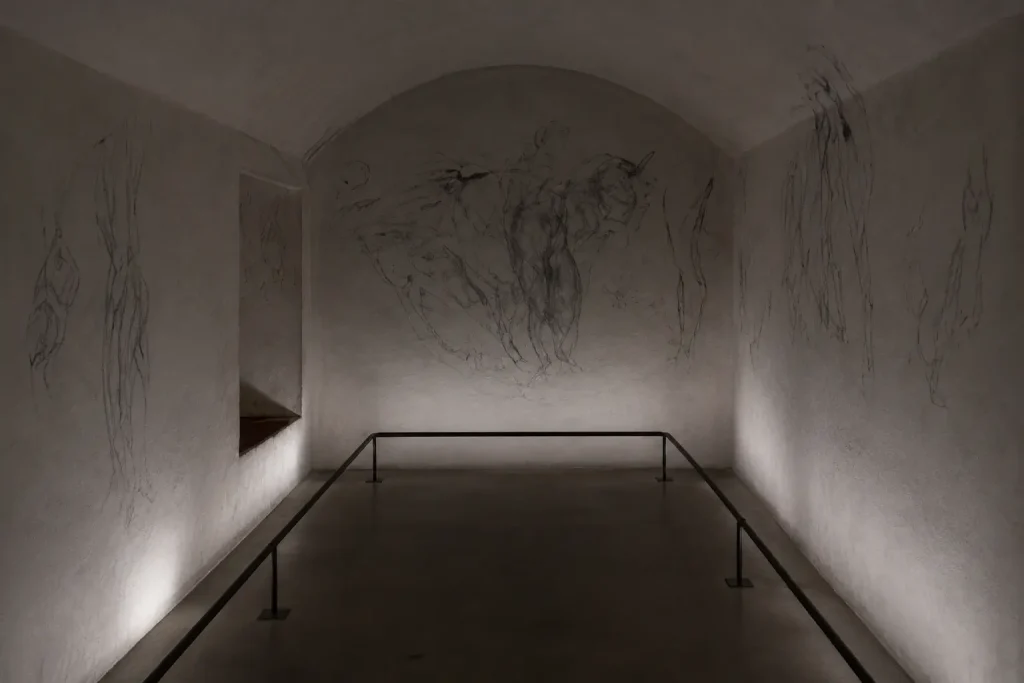
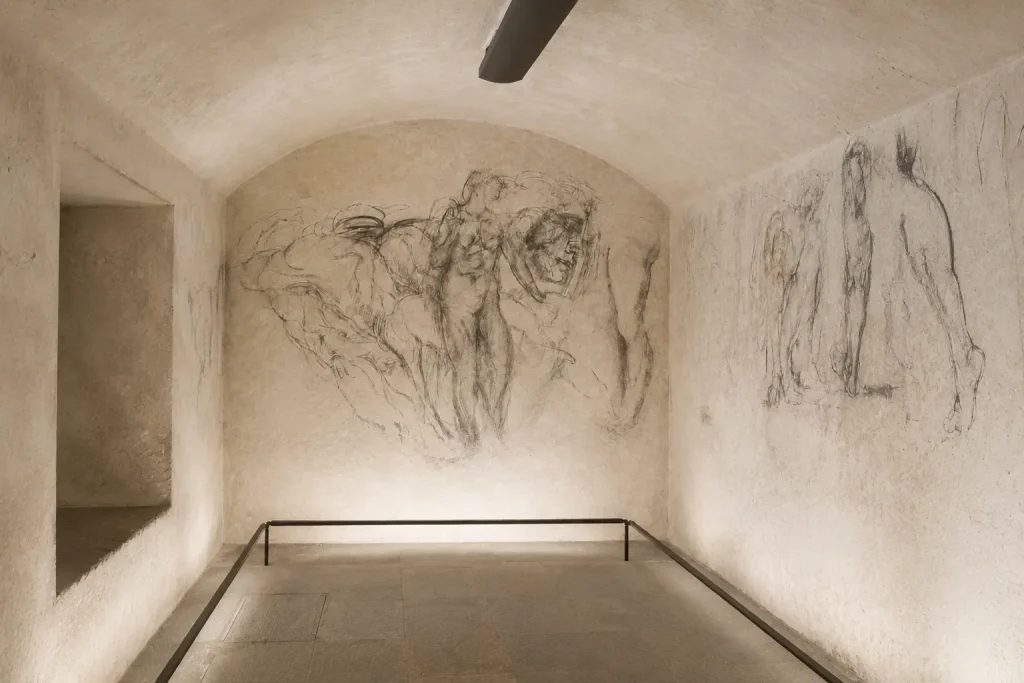
The hidden underground chamber where Michelangelo reportedly hid in 1530 — its walls still covered with mysterious charcoal sketches.
Beneath the marble grandeur of the Medici Chapels, behind a hidden trapdoor concealed under a wardrobe, lies one of Florence’s most mysterious spaces.
A tiny underground chamber.
No windows. No decoration. No luxury.
Only rough walls covered in charcoal sketches — fragments of faces, powerful muscles, unfinished figures, nervous lines frozen in darkness.
For centuries, nobody knew this room existed.
Today, it is known as Michelangelo’s Secret Room — a hidden refuge where Michelangelo Buonarroti is believed to have hidden in 1530 while fearing execution after the fall of the Florentine Republic.
But this is not just another hidden room in Florence.
It is something far more intimate.
A private space where one of history’s greatest artists may have sat alone in fear, sketching directly onto stone walls while hiding from political enemies above his head.
And because access remains extremely restricted, visiting the room still feels almost forbidden — even today.
The Great Escape: Why Michelangelo Had to Hide in 1530
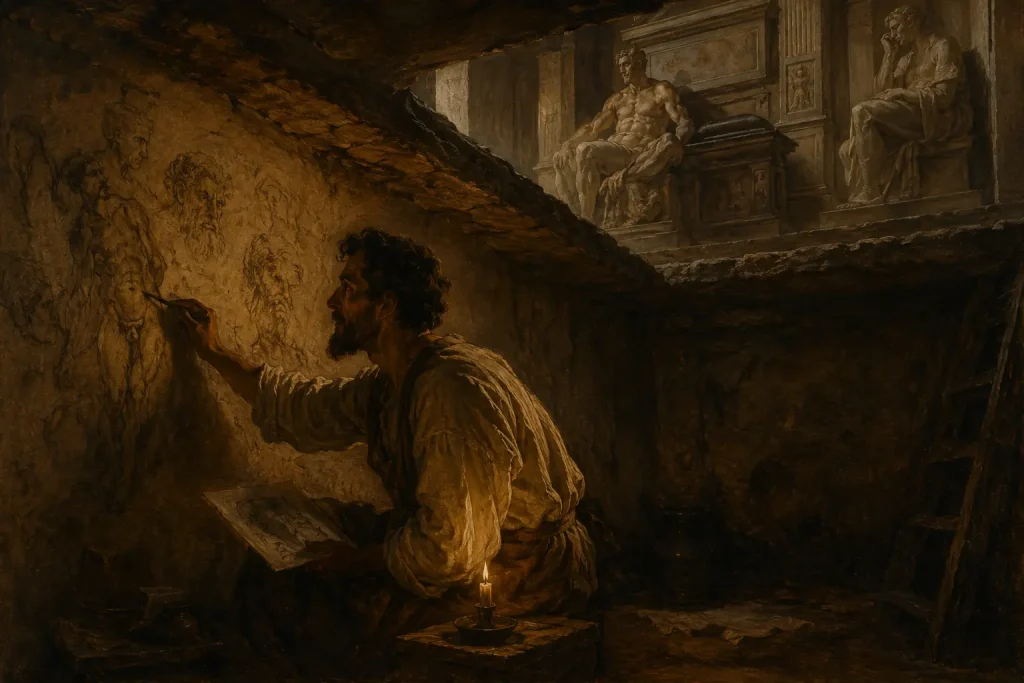
A Renaissance-style reconstruction of Michelangelo hiding beneath the Medici Chapels in 1530, sketching by candlelight inside his secret underground refuge.
To understand why Michelangelo ended up hiding underground, you need to understand the political chaos of Renaissance Florence.
For years, Michelangelo worked closely with the powerful Medici family — the dynasty that shaped Florence politically, financially, and artistically. He designed tombs for them, created sculptures for San Lorenzo, and became deeply connected to their cultural world.
But in 1527, Florence rebelled against Medici rule and briefly restored the republic.
Surprisingly, Michelangelo sided with the republic instead of his former patrons.
He even helped design military fortifications during the siege of Florence, turning from court artist into something closer to a political dissident.
When the republic collapsed in 1530 and the Medici returned to power with support from Pope Clement VII — himself a Medici — Michelangelo feared severe punishment.
Possibly imprisonment.
Possibly execution.
So he vanished.
According to historical accounts, Michelangelo spent roughly two months hiding beneath the New Sacristy of the Medici Chapels in near-total isolation.
The psychological contrast is extraordinary.
Above him stood the magnificent marble tombs he had created for the Medici family.
Below them sat the artist himself — hiding from the very people who commissioned those masterpieces.
It remains one of the strangest and most human stories of the Renaissance.
Lost and Found: The Accidental Discovery of 1975
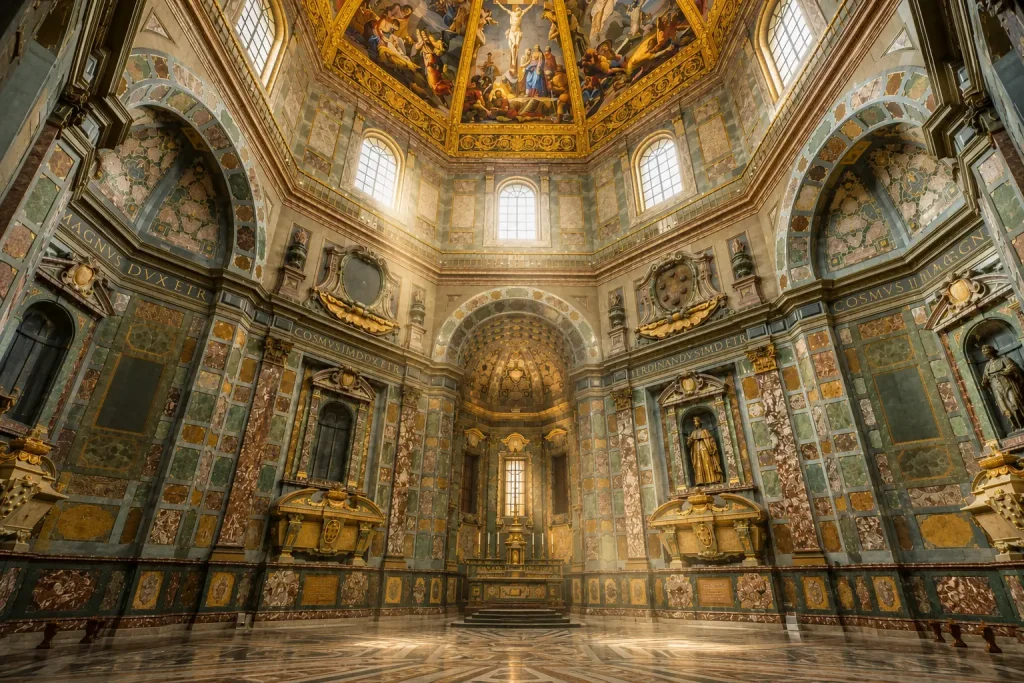
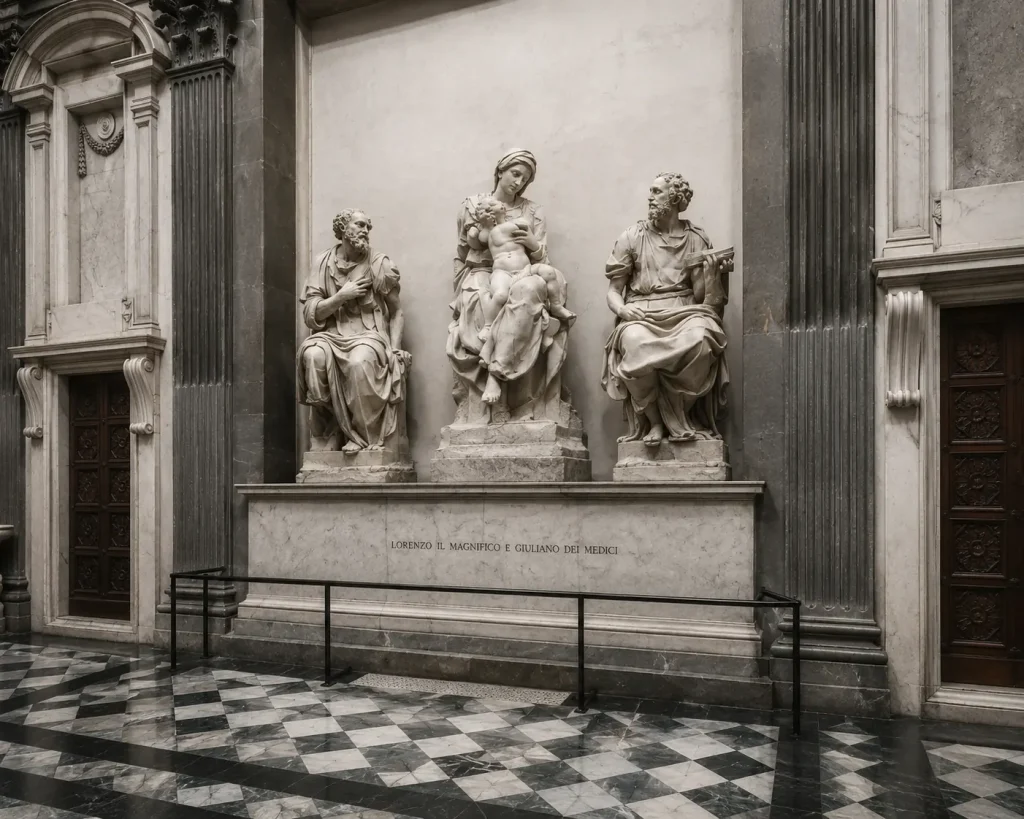
The magnificent interior of the Medici Chapels — directly above the hidden underground chamber where Michelangelo Buonarroti is believed to have hidden in 1530.
For centuries, the room disappeared from history.
Then, almost by accident, it was rediscovered in 1975.
Paolo Dal Poggetto, the director of the Medici Chapels museum, was searching for a possible new tourist exit route through unused underground areas beneath the complex.
Workers began clearing a neglected basement space.
At the time, the chamber reportedly functioned as a storage room for coal and miscellaneous materials.
The walls were covered in plaster and dirt.
But during restoration work, faint markings began emerging beneath the surface.
At first, they looked insignificant.
Then outlines of bodies appeared.
Legs.
Profiles.
Muscular torsos.
Art historians quickly realized this was no ordinary basement.
Dal Poggetto became convinced that many of the drawings were connected directly to Michelangelo himself. While some academic debate still exists over whether every sketch came from the master’s own hand, the stylistic similarities are impossible to ignore.
The discovery shocked the art world.
Unlike polished Renaissance masterpieces displayed under perfect museum lighting, these sketches felt raw, unfinished, almost vulnerable.
Not art made for patrons.
Not art made for fame.
Just thoughts escaping onto stone walls in silence.
The Sketches: A Private Masterclass in Charcoal
The rough charcoal drawings inside Michelangelo’s Secret Room reveal the raw creative process of Michelangelo Buonarroti during his alleged hiding period beneath the Medici Chapels in 1530.
Walking into the room feels less like entering a museum and more like stepping inside a Renaissance sketchbook.
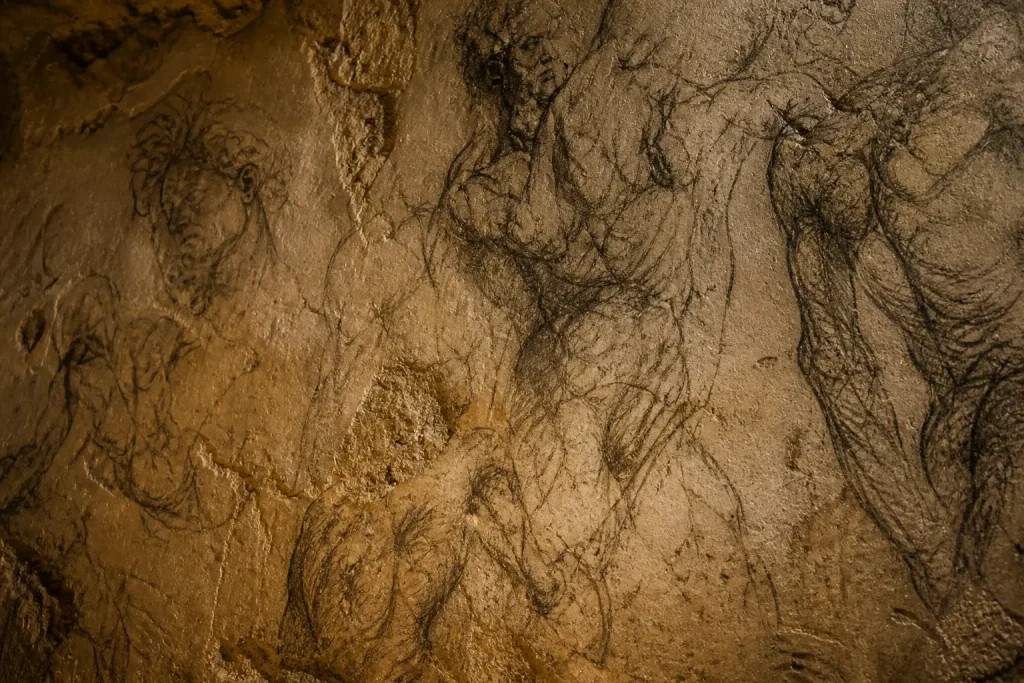
The walls are crowded with overlapping charcoal and chalk drawings.
Nothing is framed.
Nothing is polished.
Figures emerge from darkness and dissolve again into cracked plaster.
And that is exactly what makes the room unforgettable.
You are not looking at finished masterpieces.
You are looking at process.
Some sketches resemble fragments of Michelangelo’s known works:
Forms inspired by the famous Laocoön sculpture
Anatomical studies echoing the style of David
Powerful muscular poses linked to the Medici tombs
Draft-like figures connected to Giuliano de’ Medici’s monument upstairs
One of the most fascinating details is how the underground sketches connect directly to the sculptures above your head.
Look carefully for forms resembling the famous “Day” and “Night” figures.
Then, once you leave the basement and enter the New Sacristy, compare them with the finished marble versions upstairs.
Suddenly, the entire Medici Chapels complex starts feeling like a three-dimensional timeline of Michelangelo’s creative process — from nervous charcoal ideas to immortal stone masterpieces.
The emotional energy of the room is extraordinary.
Certain lines feel rushed and anxious.
Others are delicate and surprisingly calm.
You can almost imagine Michelangelo standing beside candlelight, sketching onto stone walls while hiding in silence underground.
Most Renaissance masterpieces were designed for public admiration.
This room was never meant to be seen by anyone.
That changes everything.
Quick Info
Best for: Art lovers, Renaissance fans, mystery seekers, returning Florence visitors.
Location: Inside the Museo delle Cappelle Medicee near San Lorenzo.
Booking: Mandatory. Extremely limited access.
Visitor Limits: Only 4 people at a time. Roughly 100 visitors per week.
Beyond the Duomo and crowded piazzas, Florence hides secret pharmacies, forgotten towers, quiet libraries, surreal gardens, and Renaissance mysteries most tourists never see. Here are 11 hidden gems that reveal the city’s true soul.
Stanza Segreta di Michelangelo: Why the Room Feels So Different
The hidden underground chamber beneath the Medici Chapels where Michelangelo Buonarroti is believed to have hidden in 1530, leaving charcoal sketches across the walls.
Florence is filled with spectacular Renaissance spaces.
But most famous landmarks share something in common:
They are grand.
Bright.
Designed to impress.
Michelangelo’s Hidden Room is the opposite.
The ceiling feels low.
The walls feel close.
The air feels heavy.
The lighting is intentionally minimal.
Soft LED illumination barely lights the chamber, recreating something close to the candlelit atmosphere Michelangelo likely experienced while hiding there in 1530.
That subtle decision changes the emotional experience completely.
Instead of feeling like a modern museum, the room feels suspended somewhere between archaeology and memory.
There are no massive tourist crowds.
No loud conversations.
No endless camera flashes.
The experience feels strangely personal — almost as if you accidentally discovered a place you were never supposed to enter.
And that contrast matters.
Upstairs, the Medici Chapels celebrate political power, immortality, and marble perfection.
Downstairs, the secret room reveals fear, survival, vulnerability, and raw artistic instinct.
It shows Michelangelo not as a myth…
…but as a human being.
How to Visit Michelangelo’s Hidden Room
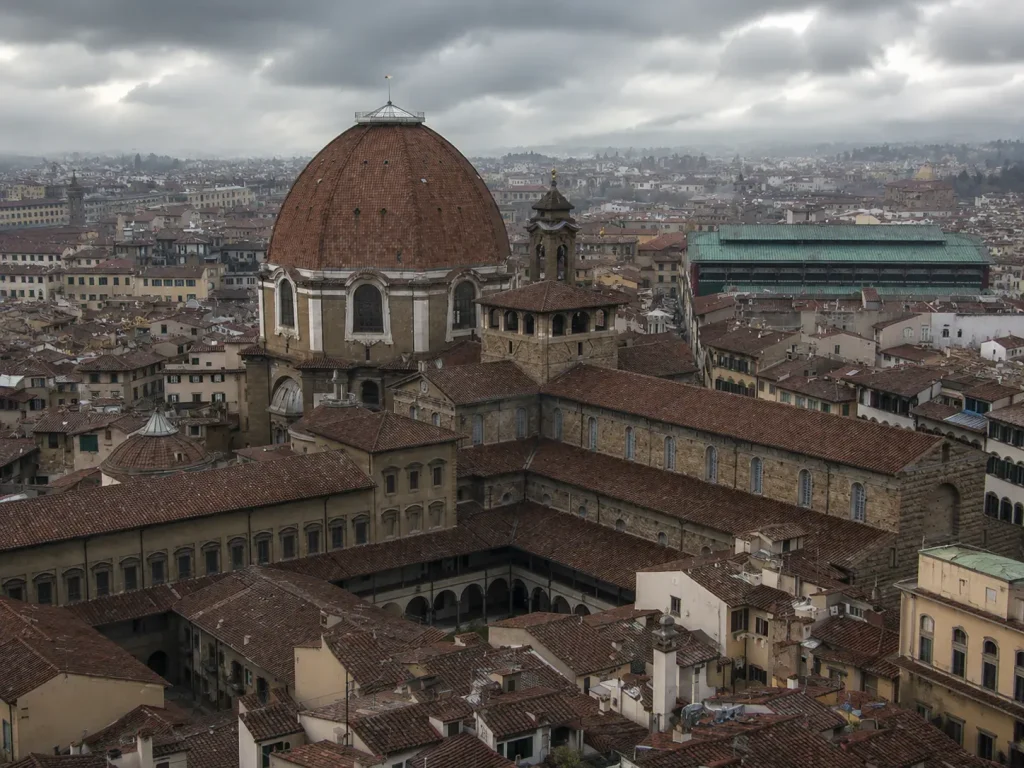
A dramatic aerial view of the Medici Chapels and the surrounding San Lorenzo district in Florence under a moody Tuscan sky.
Visiting the room is not easy.
And honestly, that difficulty is part of what makes the experience special.
Note for Travelers: Don’t Confuse the Entrances
Many visitors accidentally enter the wrong building.
The Basilica of San Lorenzo and the Medici Chapels have separate entrances.
The Secret Room is accessed through the Museo delle Cappelle Medicee — NOT through the main San Lorenzo Basilica entrance.
Look for the museum entrance around the back side of the church complex.
This small detail alone can save you significant stress if you are rushing to a timed reservation.
Book Months Ahead
Tickets are extremely limited and often disappear almost immediately after release.
If Florence is part of a larger Italy trip, reserve this experience as early as possible — especially during spring and summer.
Practical Booking Tips
Check the official B-Ticket website every Tuesday and Friday, when new availability often appears.
Try the ticket office around 8:15 AM if online tickets are sold out — occasional last-minute cancellations do happen.
Avoid relying on third-party resellers unless absolutely necessary. Prices can become dramatically inflated.
Because access is capped at roughly 100 visitors per week, this is one of the hardest museum tickets to secure in Florence.
Small Groups Only
Visits happen in tiny groups with strict supervision.
This protects both the room and the fragile drawings.
Unlike crowded museums, nobody rushes around taking endless selfies or talking loudly.
The silence becomes part of the experience.
Time Limit: 15 Minutes
You only get about 15 minutes inside the room.
At first, that sounds disappointing.
But once you enter the chamber, you quickly understand why the restriction exists.
The room is physically tiny, and excessive humidity from visitors could damage the charcoal sketches over time.
In reality, 15 minutes inside such an emotionally intense space feels longer than you expect.
Not Recommended for Everyone
The staircase leading underground is narrow and steep.
The enclosed atmosphere can feel uncomfortable for visitors with claustrophobia.
Children under 10 are generally not admitted.
If you strongly dislike confined spaces, this may be one of the few Florence attractions worth skipping.
Practical Tips for Photographers
Photography policies may change depending on conservation rules, but flash photography is strictly forbidden.
And honestly, that restriction makes perfect sense.
The drawings are extremely fragile.
If photography is permitted during your visit, your smartphone’s low-light mode will be your best friend.
Do not expect bright museum lighting.
The room is intentionally dim to preserve both the sketches and the atmosphere.
Hidden Gems in Venice
Venice is more than gondolas and crowded canals. Step away from the tourist routes and discover quiet districts, hidden courtyards, and places where the city feels truly authentic.
A deeply emotional atmosphere unlike traditional museums
Incredible connection between underground sketches and the finished marble sculptures upstairs
Cons
Expensive tickets (often €20+ depending on access type)
Extremely difficult to book
Strictly timed visit
Only around 15 minutes inside
Potentially uncomfortable for claustrophobic visitors
This is not a standard tourist attraction.
It feels closer to a pilgrimage for people fascinated by Michelangelo, Florence, and Renaissance history.
And for the right traveler, it can easily become one of the most memorable experiences in the city.
What It Feels Like to Stand Inside
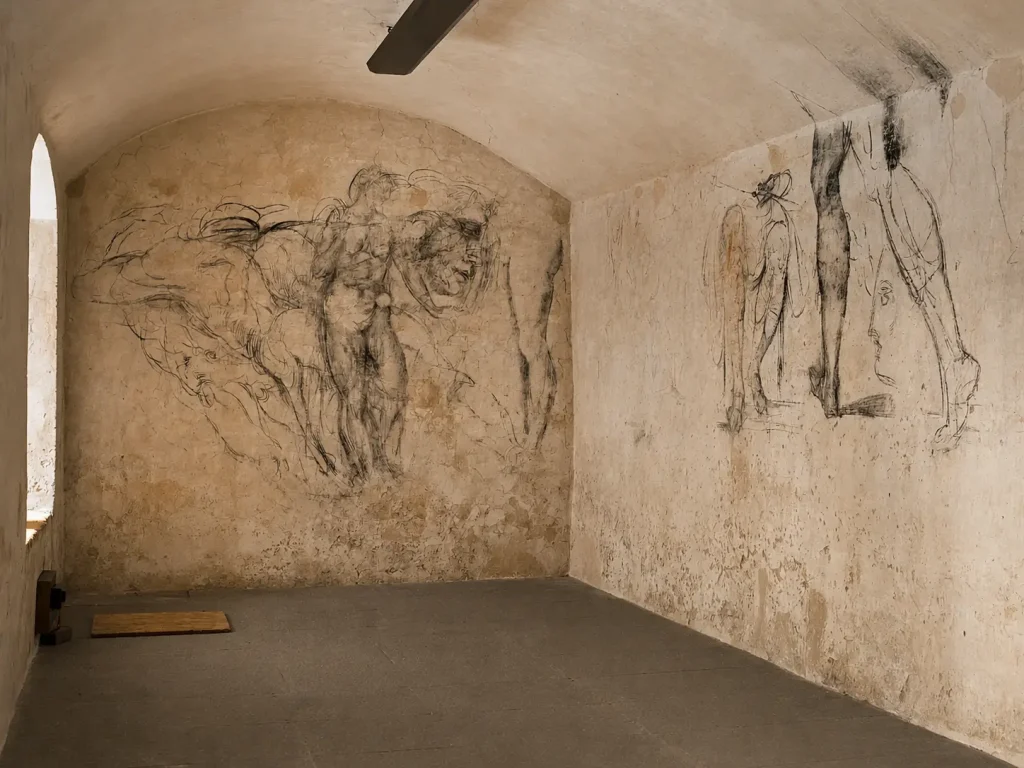
A detailed view inside Michelangelo’s Secret Room beneath the Medici Chapels, featuring unfinished charcoal sketches associated with Michelangelo’s hidden refuge in 1530.
The first thing you notice is the silence.
Not museum silence.
Underground silence.
Heavy silence.
Then your eyes slowly adjust to the darkness, and the sketches begin emerging from the walls almost like ghosts.
A shoulder.
A face.
A leg.
Half-visible figures floating through cracked plaster.
The room does not feel cinematic or polished.
It feels fragile.
Temporary.
Human.
And maybe that is why it affects visitors so deeply.
You are standing inches away from marks likely drawn by one of history’s greatest artists during a moment of fear and uncertainty.
Not during triumph.
Not during celebration.
But during survival.
Very few museum experiences create that kind of emotional closeness.
Little-Known Facts About Michelangelo’s Secret Room
The Room Was Probably Known to Very Few People
The hiding place was so discreet that even many workers within the Medici complex likely never knew it existed.
Its entrance was concealed behind furniture and accessible through a hidden trapdoor.
Some Drawings May Have Been Practice Studies
Several sketches appear unfinished or repetitive, suggesting Michelangelo may have used the walls almost like a visual notebook — experimenting with anatomy, movement, and composition while hiding underground.
Humidity Is a Constant Threat
The room’s charcoal drawings are incredibly delicate.
Even human breath slightly changes the humidity levels inside the chamber.
That is one of the main reasons visitor numbers remain so strictly limited today.
The Discovery Sparked Academic Debate
Not every art historian agrees that every drawing was made personally by Michelangelo.
However, even skeptical scholars acknowledge the overwhelming stylistic connection to his artistic methods and workshop traditions.
That uncertainty actually makes the room even more fascinating.
What to See Next Nearby
The Medici Chapels
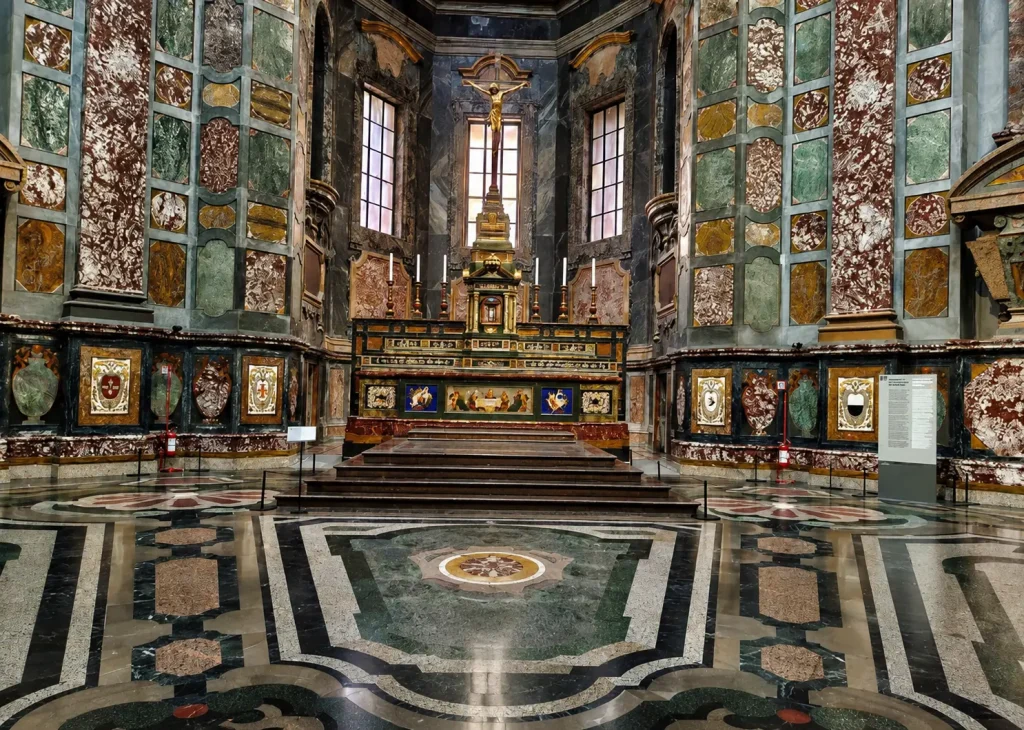
The magnificent marble interior of the Medici Chapels — one of Florence’s greatest Renaissance masterpieces and the site connected to Michelangelo’s legendary hidden room beneath the chapel complex.
Before or after visiting the hidden room, spend time inside the main Medici Chapels itself.
The contrast is extraordinary.
Upstairs, you see Michelangelo’s finished marble masterpieces — elegant, monumental, immortal.
Downstairs, you encounter rough sketches and unfinished artistic thoughts.
Experiencing both on the same day completely changes how you understand the artist.
Orsanmichele
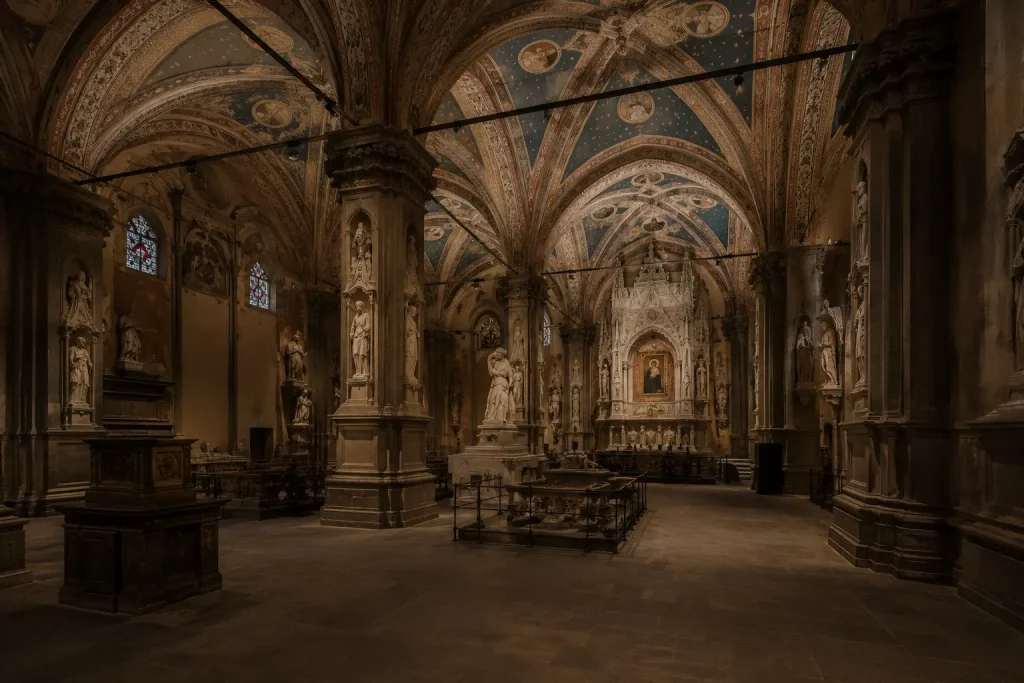
The atmospheric interior of Orsanmichele Church — one of Florence’s most unique Gothic-Renaissance landmarks hidden in the heart of the historic center.
Located roughly 7 minutes away on foot, this remarkable church is another perfect example of Florence hiding secrets in plain sight.
From the outside, it barely resembles a traditional church.
Inside, it reveals Gothic architecture, hidden symbolism, and one of the city’s most underrated interiors.
If you enjoy mysterious Florence, it pairs perfectly with Michelangelo’s Secret Room.
Basilica of San Lorenzo
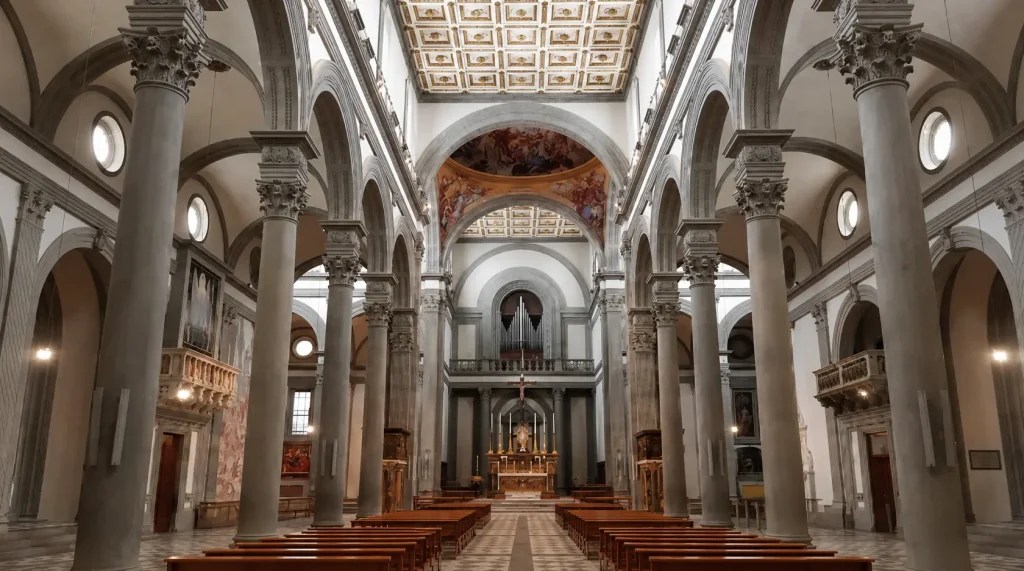
The monumental interior of Basilica of San Lorenzo — one of Florence’s oldest and most historically important Renaissance churches.
Do not skip the nearby Basilica of San Lorenzo itself.
This was the Medici family’s spiritual center and one of the most historically important churches in Florence.
Knowing that Michelangelo once hid directly beneath this complex changes the emotional feeling of the entire area.
Final Thoughts
Florence is filled with masterpieces.
But Michelangelo’s Secret Room offers something rarer than beauty.
It offers proximity.
A direct emotional connection to fear, survival, creativity, and human vulnerability.
You are not simply observing Renaissance history here.
You are standing inside it.
And because access remains so limited, the experience still feels secret — even five centuries later.
FAQ
Is Michelangelo’s Secret Room worth visiting?
Yes — especially if you love Renaissance history, hidden places, or Michelangelo himself. Unlike Florence’s large museums, the Secret Room feels deeply personal and almost unsettlingly intimate. You are not looking at polished masterpieces behind glass. You are standing inside a cramped underground refuge covered with rough charcoal sketches believed to be connected to Michelangelo’s creative process. That said, this experience is not for everyone. Visits are expensive, extremely short, and difficult to book. If you prefer “big highlights” and fast sightseeing, the regular Medici Chapels may be enough. But for art lovers and history enthusiasts, this is easily one of the most unforgettable experiences in Florence.
Where is Michelangelo’s Secret Room located?
Michelangelo’s Secret Room is located beneath the Medici Chapels near the Basilica of San Lorenzo in central Florence. Important for travelers: the entrance is NOT through the main Basilica of San Lorenzo. You must enter through the Museo delle Cappelle Medicee entrance located behind the church complex.
How hard is it to get tickets?
ery hard. Access is strictly limited to protect the fragile drawings and underground environment. Only a few visitors are allowed inside each day, usually in tiny groups with a fixed schedule. Tickets often sell out weeks or even months in advance — especially during spring and summer. Practical tip: – Check the official B-Ticket website frequently. – New ticket availability often appears on Tuesdays and Fridays. – If everything is sold out, arrive early in the morning and ask about cancellations. This is one of the hardest museum tickets to secure in Florence right now.
Can you visit the Secret Room without the Medici Chapels?
No. The Secret Room visit is connected to the Medici Chapels experience and requires a special reservation tied to the museum complex. Most visitors first explore the chapels and then descend underground to the hidden chamber during their scheduled time slot.
How long does the visit last?
The visit inside the Secret Room itself lasts only about 15 minutes. This may sound short, but the room is extremely small and enclosed. The time restriction helps protect the delicate charcoal sketches from humidity, heat, and excessive exposure to light. Because of the silence and atmosphere underground, those 15 minutes usually feel much longer emotionally.
Why did Michelangelo hide there?
According to historical tradition, Michelangelo Buonarroti hid inside this underground room around 1530 during political turmoil in Florence. Michelangelo had supported the Florentine Republic against the Medici family. When the Medici returned to power with the support of Pope Clement VII, the artist feared political persecution and possible punishment. He is believed to have spent several weeks hiding beneath the Medici Chapels — ironically beneath the same complex he had helped design and decorate.
Are the sketches authentic?
This remains one of the most fascinating debates surrounding the room. Many art historians believe at least some of the charcoal drawings are connected to Michelangelo because the anatomy, style, and figure studies strongly resemble his known works and unfinished sketches. However, not every drawing can be definitively attributed to him. Some experts believe assistants or later visitors may also have contributed marks on the walls over time. Even with this uncertainty, the room is widely accepted as an extraordinary and historically important Renaissance discovery.
Is photography allowed inside?
Photography rules can change depending on conservation conditions and museum policies. Generally: – Flash photography is strictly forbidden. – Tripods and professional equipment are not allowed. – Lighting inside is intentionally kept very low to protect the sketches. If photography is permitted during your visit, low-light mode on a smartphone is your best option. But honestly, this is one of those rare places where most visitors stop thinking about photos after a few minutes. The atmosphere becomes the real memory.
Is Michelangelo’s Secret Room worth visiting?
Yes — especially if you love Renaissance history, hidden places, or Michelangelo himself. Unlike Florence’s large museums, the Secret Room feels deeply personal and almost unsettlingly intimate. You are not looking at polished masterpieces behind glass. You are standing inside a cramped underground refuge covered with rough charcoal sketches believed to be connected to Michelangelo’s creative process.
That said, this experience is not for everyone. Visits are expensive, extremely short, and difficult to book. If you prefer “big highlights” and fast sightseeing, the regular Medici Chapels may be enough. But for art lovers and history enthusiasts, this is easily one of the most unforgettable experiences in Florence.
Where is Michelangelo’s Secret Room located?
Michelangelo’s Secret Room is located beneath the Medici Chapels near the Basilica of San Lorenzo in central Florence.
Important for travelers: the entrance is NOT through the main Basilica of San Lorenzo. You must enter through the Museo delle Cappelle Medicee entrance located behind the church complex.
How hard is it to get tickets?
Very hard. Access is strictly limited to protect the fragile drawings and underground environment. Only a few visitors are allowed inside each day, usually in tiny groups with a fixed schedule.
Tickets often sell out weeks or even months in advance — especially during spring and summer.
Practical tip:
Check the official B-Ticket website frequently.
New ticket availability often appears on Tuesdays and Fridays.
If everything is sold out, arrive early in the morning and ask about cancellations.
This is one of the hardest museum tickets to secure in Florence right now.
Can you visit the Secret Room without the Medici Chapels?
No. The Secret Room visit is connected to the Medici Chapels experience and requires a special reservation tied to the museum complex.
Most visitors first explore the chapels and then descend underground to the hidden chamber during their scheduled time slot.
How long does the visit last?
The visit inside the Secret Room itself lasts only about 15 minutes.
This may sound short, but the room is extremely small and enclosed. The time restriction helps protect the delicate charcoal sketches from humidity, heat, and excessive exposure to light.
Because of the silence and atmosphere underground, those 15 minutes usually feel much longer emotionally.
Why did Michelangelo hide there?
According to historical tradition, Michelangelo Buonarroti hid inside this underground room around 1530 during political turmoil in Florence.
Michelangelo had supported the Florentine Republic against the Medici family. When the Medici returned to power with the support of Pope Clement VII, the artist feared political persecution and possible punishment.
He is believed to have spent several weeks hiding beneath the Medici Chapels — ironically beneath the same complex he had helped design and decorate.
Are the sketches authentic?
This remains one of the most fascinating debates surrounding the room.
Many art historians believe at least some of the charcoal drawings are connected to Michelangelo because the anatomy, style, and figure studies strongly resemble his known works and unfinished sketches.
However, not every drawing can be definitively attributed to him. Some experts believe assistants or later visitors may also have contributed marks on the walls over time.
Even with this uncertainty, the room is widely accepted as an extraordinary and historically important Renaissance discovery.
Is photography allowed inside?
Photography rules can change depending on conservation conditions and museum policies.
Generally:
Flash photography is strictly forbidden.
Tripods and professional equipment are not allowed.
Lighting inside is intentionally kept very low to protect the sketches.
If photography is permitted during your visit, low-light mode on a smartphone is your best option.
But honestly, this is one of those rare places where most visitors stop thinking about photos after a few minutes. The atmosphere becomes the real memory.