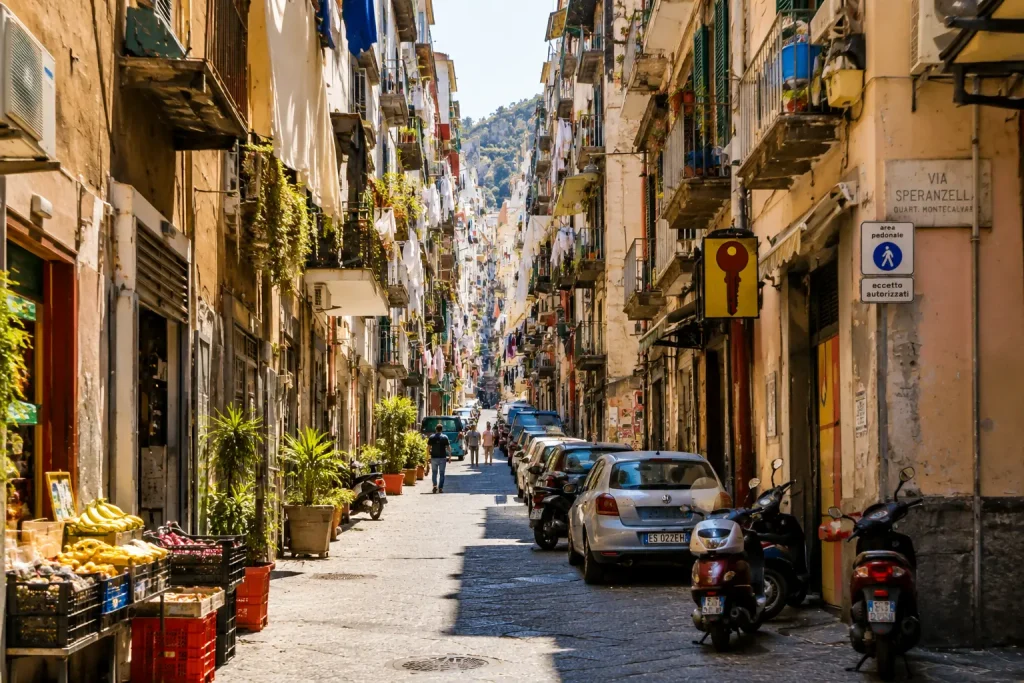
The vibrant streets of Quartieri Spagnoli capture the authentic soul of Naples with historic alleyways, Maradona murals, hanging laundry, and everyday Neapolitan life.
If you want to understand the true spirit of Naples, forget the polished façades and postcard-perfect piazzas for a moment. Welcome to Quartieri Spagnoli — the Spanish Quarters — a dense maze of narrow alleyways where life spills directly into the streets.
Laundry hangs above your head between centuries-old buildings. Scooters squeeze through passages barely wider than a doorway. Elderly locals sit outside chatting across balconies while the smell of fried dough, espresso, and tomato sauce drifts through the air. Somewhere nearby, a Diego Maradona shrine glows with candles and football scarves.
For decades, Quartieri Spagnoli carried a rough reputation. Today, it has transformed into one of the most vibrant and culturally fascinating neighborhoods in Naples. It remains raw, energetic, loud, emotional, and intensely alive — exactly what many travelers hope to find when searching for the “real” Italy.
This guide will help you explore the district respectfully, safely, and beyond the clichés.
A Brief History: From Spanish Garrison to Cultural Icon
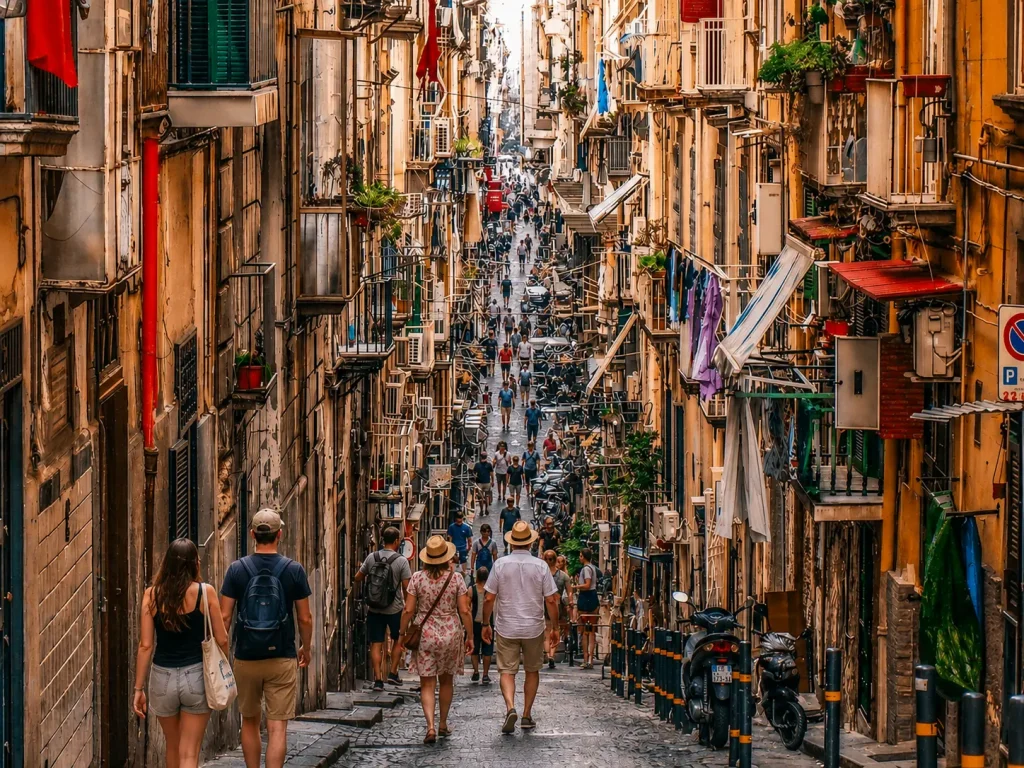
A vibrant street in Quartieri Spagnoli, Naples, filled with tourists, scooters, balconies, and the everyday atmosphere of authentic Naples.
Quartieri Spagnoli was created in the 16th century during Spanish rule over Naples. The neighborhood was originally designed to house Spanish soldiers stationed near the city center.
The district’s layout still reflects its military origins. Streets were built in a rigid grid climbing the hillside beneath the Vomero district. Over time, however, the area evolved far beyond its original purpose.
Because of its density, relative isolation, and strong local identity, Quartieri Spagnoli gradually became almost a “city within a city.” Families lived here for generations, often inside the same apartment buildings for decades. Many residents rarely needed to leave the neighborhood because everything existed within walking distance — food shops, churches, tailors, workshops, and daily social life.
Architecturally, the district is chaotic but unforgettable. Tiny apartments stack vertically above narrow lanes. Balconies nearly touch each other overhead. Some alleys are so narrow that sunlight reaches them only briefly each day.
This compressed urban design accidentally created one of the most visually distinctive neighborhoods in Italy.
Why Quartieri Spagnoli is the Heart of Authentic Naples
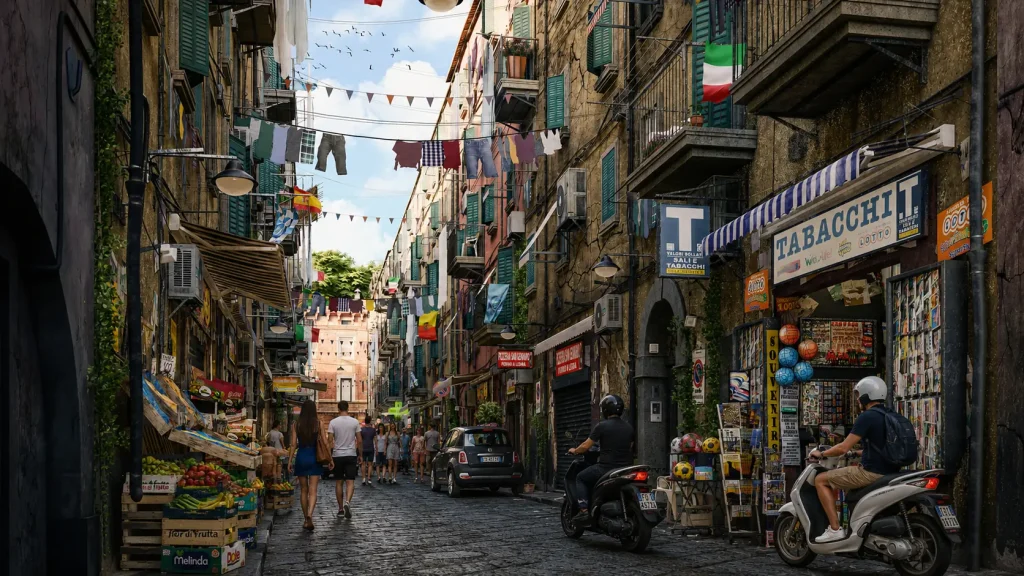
A lively street inside Quartieri Spagnoli in Naples, featuring local shops, scooters, hanging laundry, and the authentic atmosphere of the Spanish Quarters.
The Living Room of the City
In many cities, the street is simply a route from one destination to another. In Quartieri Spagnoli, the street is the living room.
People cook, argue, laugh, repair scooters, play football, and socialize outside their homes. Windows stay open. Conversations travel between floors. Children race through alleys while locals lean from balconies discussing football, politics, or dinner plans.
For visitors, this creates an unusually immersive experience. You are not walking through a tourist district designed for outsiders. You are moving through a functioning neighborhood where daily life itself is the main attraction.
That authenticity is exactly why the area has become so popular with photographers, filmmakers, food lovers, and travelers searching for authentic Naples neighborhoods.
The Maradona Cult
No figure defines modern Naples more than Diego Maradona.
When Maradona played for Napoli in the 1980s, he transformed not only the football club, but the identity of the city itself. For many Neapolitans, he represented pride, rebellion, and southern resilience against wealthier northern Italy.
In Quartieri Spagnoli, that devotion became something close to a religion.
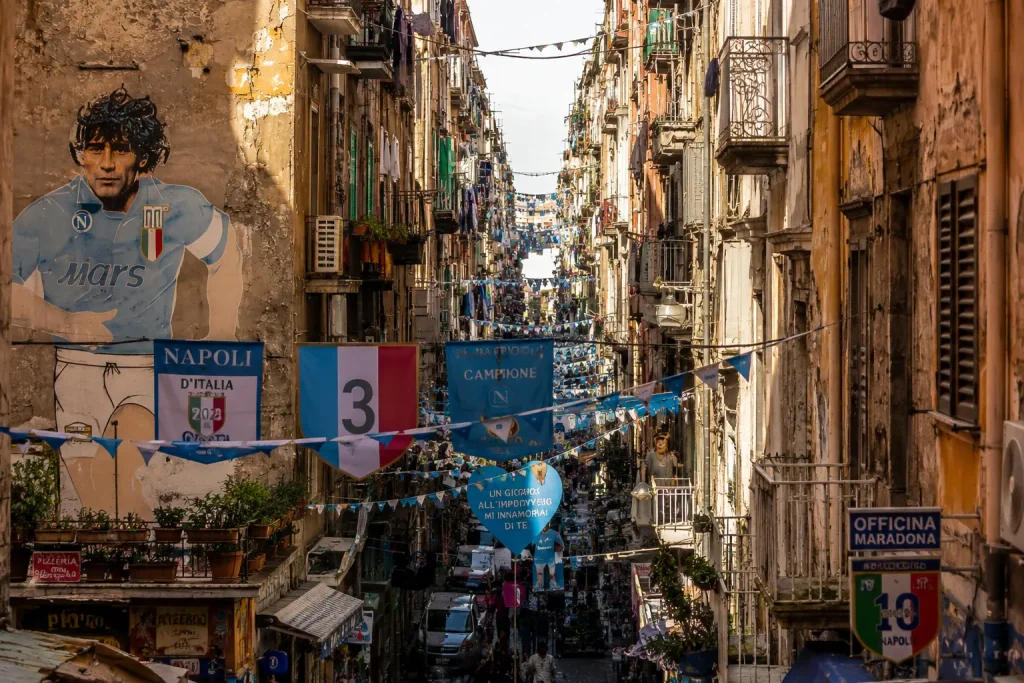
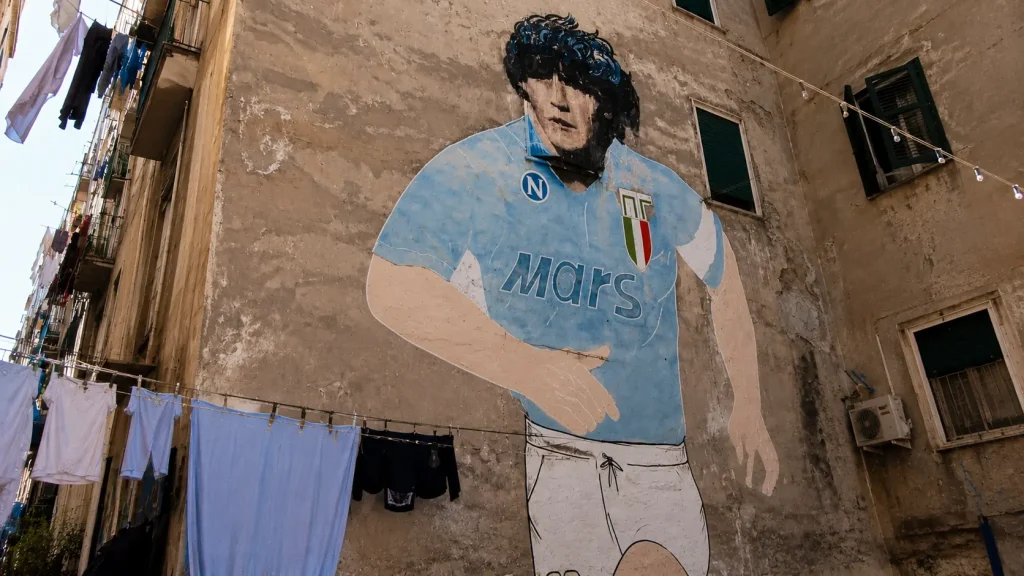
The famous Maradona mural on Via Emanuele de Deo has become one of the most visited spots in Naples. What began as a local tribute evolved into a cultural pilgrimage site filled with scarves, candles, handwritten messages, football jerseys, and street shrines.
But the “Maradona cult” extends far beyond one mural. His face appears everywhere — painted on shutters, pasted onto walls, hanging inside cafés, and even incorporated into religious-style altars.
Understanding this phenomenon helps visitors understand Naples itself: emotional, loyal, theatrical, and deeply passionate.
What to See and Do: A Self-Guided Walk
Start Near Via Toledo
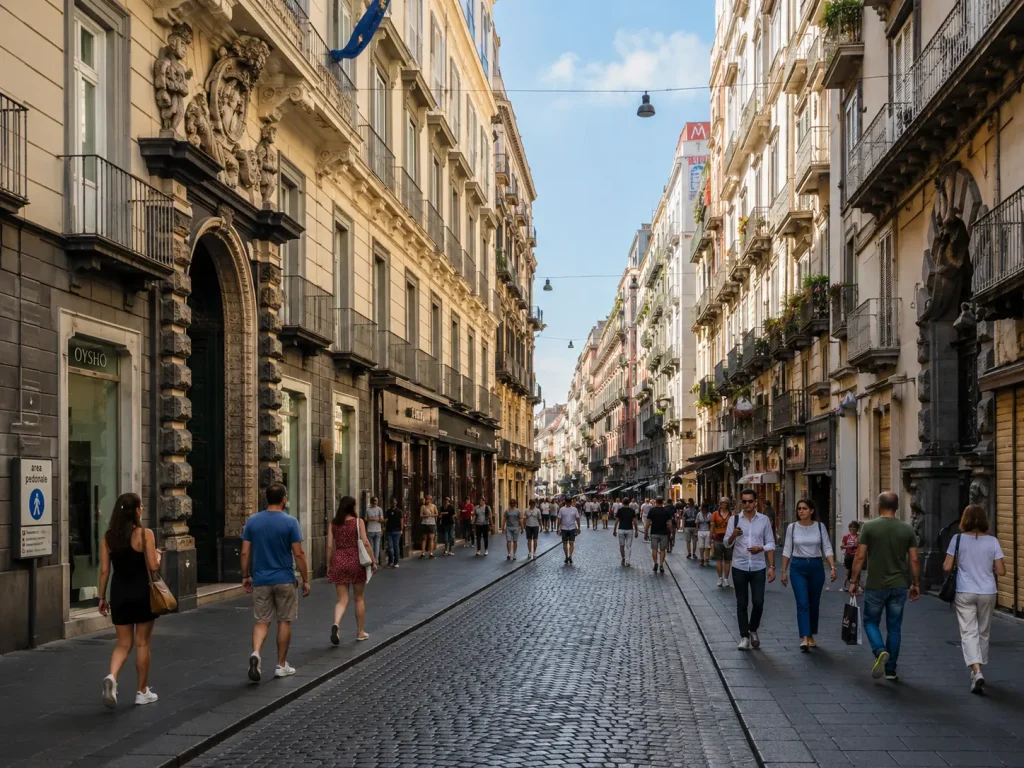
Pedestrians walking along Via Toledo in Naples, one of the city’s most famous streets and a gateway to Quartieri Spagnoli.
The best way to enter Quartieri Spagnoli is from Via Toledo, one of Naples’ main shopping streets.
The transition is immediate. One moment you are surrounded by elegant storefronts and wide sidewalks. A few steps later, you are inside a dense labyrinth of steep alleys and hanging laundry.
This contrast is part of what makes Quartieri Spagnoli so unforgettable.
The Murals: Beyond Maradona
The iconic Diego Maradona mural surrounded by hanging laundry and historic buildings in Quartieri Spagnoli, Naples.
While the Maradona mural attracts most visitors, the district contains far more street art than many travelers realize.
Murals dedicated to local legends, religious imagery, anti-mafia messages, and Neapolitan identity appear throughout the neighborhood. Some are massive and highly visible. Others hide inside tiny alleyways and staircases.
Part of the fun is discovering them accidentally.
Keep an eye out for:
Religious shrines built directly into walls
Murals of local actors and musicians
Tiny street altars with candles and flowers
Political and social commentary art
Vintage football imagery connected to Napoli’s history
Quartieri Spagnoli constantly changes visually. New pieces appear while older works fade beneath layers of posters and graffiti.
Vico Lungo Gelso: The Food Spine of the District
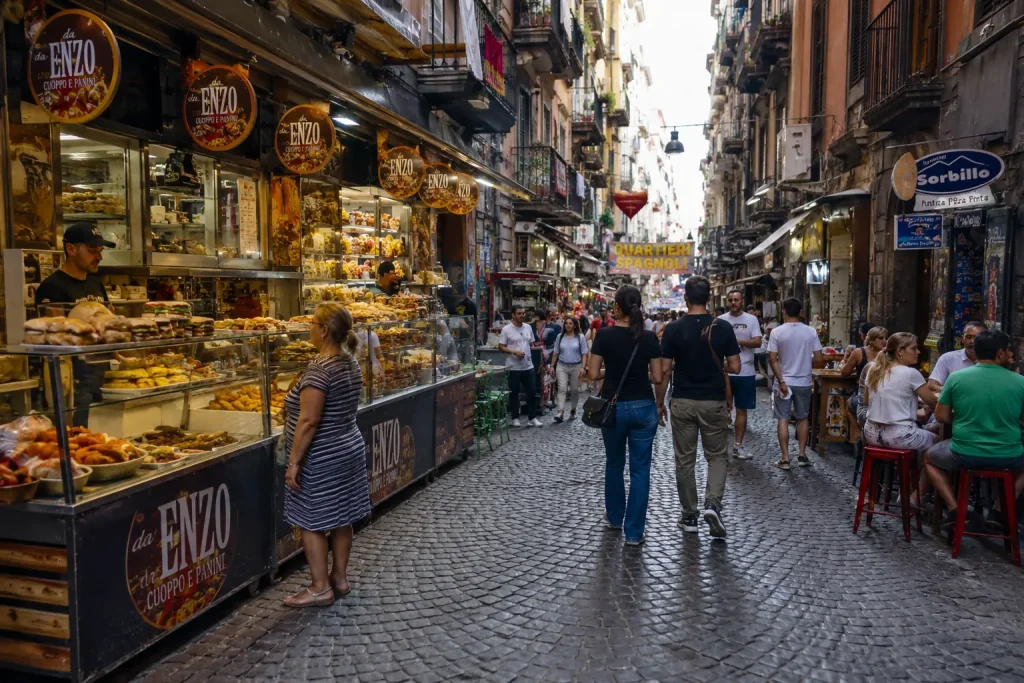
Tourists and locals exploring Vico Lungo Gelso, one of the liveliest food streets in Quartieri Spagnoli, Naples.
Vico Lungo Gelso is one of the neighborhood’s most atmospheric streets and an ideal place to experience local food culture.
This area captures the sensory overload Naples is famous for:
sizzling frying oil
shouting vendors
espresso machines steaming nonstop
scooters weaving through pedestrians
tiny kitchens producing incredible food from almost invisible storefronts
It is one of the best places in the city to try authentic street food.
Local Botteghe and Workshops
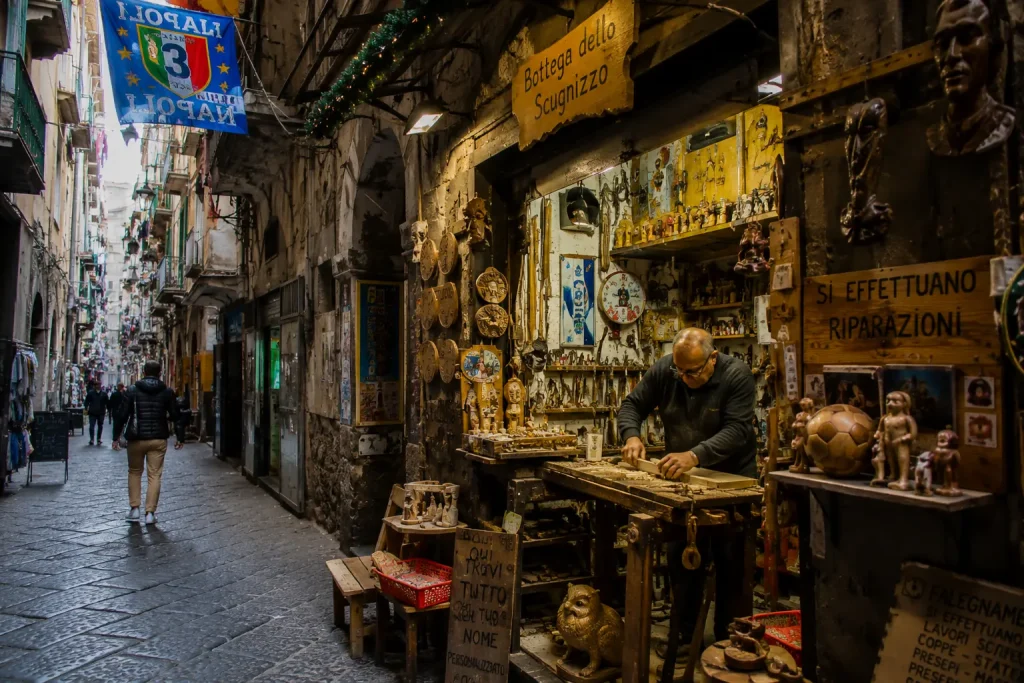
A traditional artisan workshop in Quartieri Spagnoli, Naples, where local craftsmen continue generations-old Neapolitan traditions.
Despite increasing tourism, Quartieri Spagnoli still preserves many traditional botteghe — tiny family-run workshops and stores.
You may encounter:
old tailors
leather repair shops
religious icon makers
tiny fruit stands
generations-old cafés
handmade pasta stores
Many businesses here operate exactly as they did decades ago.
This surviving local economy is one reason the neighborhood still feels authentic instead of “museumified.”
Dining in the Spanish Quarters: Where to Eat
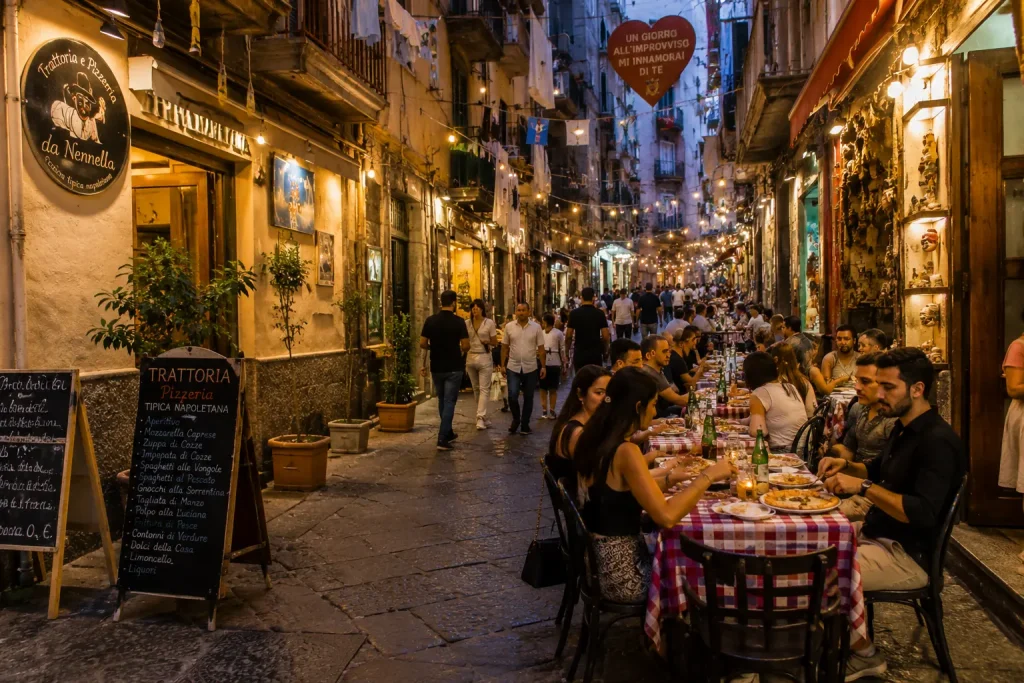
Evening dining scene in Quartieri Spagnoli, where traditional Neapolitan restaurants spill into the narrow streets of Naples.
Quartieri Spagnoli is one of the best food neighborhoods in Naples precisely because it remains heavily local.
Instead of searching for polished fine dining, embrace the street-food culture.
Must-Try Foods
Pizza a Portafoglio
Literally “wallet pizza,” this is a small folded pizza designed to be eaten while walking.
Hot, cheap, fast, and deeply Neapolitan.
Cuoppo
A paper cone filled with fried seafood, vegetables, or mixed snacks.
Perfect for wandering through the alleys.
Frittatina di Pasta
One of Naples’ greatest comfort foods — fried pasta mixed with béchamel, cheese, and often ham or minced meat.
Espresso and Sfogliatella
Stop frequently for coffee. In Naples, espresso is not simply a drink — it is a ritual.
Pair it with a flaky sfogliatella pastry for the full experience.
A Practical Food Tip
The busiest places are often the best sign.
If locals are crowding around a tiny counter and eating standing up, you are probably in the right place.
Hidden Gems in Naples
Beyond the pizza shops, chaotic traffic, and famous waterfront views, Naples hides ancient underground cities, forgotten Roman theatres, secret tunnels, mysterious churches, hidden palaces, and candlelit passages buried beneath centuries of history. Here are the hidden gems that reveal the city’s most fascinating and authentic side.
A sunlit street in Quartieri Spagnoli, Naples, filled with hanging laundry, scooters, balconies, and authentic Neapolitan atmosphere.
Is Quartieri Spagnoli Safe?
This is one of the most searched questions about the district.
The honest answer: yes, Quartieri Spagnoli is generally safe for tourists today, especially during daytime and evening hours when the streets are busy and active.
The neighborhood has changed significantly over the past decade thanks to tourism, new businesses, street art projects, and increased visibility.
That said, this remains a dense urban neighborhood — not a sanitized tourist zone.
Use normal big-city awareness:
keep valuables secure
avoid flashing expensive items
stay aware of scooters in narrow streets
avoid wandering into completely empty alleys very late at night
Most visitors experience the district as lively, welcoming, and memorable rather than intimidating.
Etiquette: How to Respect the Neighborhood
Remember that people actually live here.
Quartieri Spagnoli is not an open-air theme park created for Instagram.
A few simple rules make a big difference:
avoid photographing residents without permission
keep noise reasonable at night
do not block narrow streets while taking photos
support local businesses when possible
be patient with scooters and local traffic
Visitors who approach the area respectfully usually receive warmth in return.
The Geometry of Streets
Quartieri Spagnoli is notorious for confusing navigation apps.
The steep vertical layout, staircases, narrow passages, and overlapping alleys can make GPS unreliable.
Instead of relying entirely on Google Maps, use major landmarks:
Via Toledo
the Maradona mural
nearby funicular stations
church façades
main staircases
Honestly, getting slightly lost is part of the experience.
Hidden Stories and Lesser-Known Facts
The Shrines of Naples
One of the most fascinating details in Quartieri Spagnoli is the enormous number of tiny street shrines.
Some are religious. Others honor football players, local musicians, or deceased relatives.
At night, many glow with blue or red lights, creating an atmosphere that feels almost cinematic.
This blending of Catholic symbolism, superstition, football culture, and neighborhood identity is uniquely Neapolitan.
The Soundscape of the District
Quartieri Spagnoli has its own soundtrack.
You may hear:
Neapolitan songs from open windows
football commentary echoing through bars
church bells
shouting between balconies
scooters accelerating uphill
frying oil crackling from kitchens
The district is experienced as much through sound as through visuals.
How to Combine Your Visit
Quartieri Spagnoli works perfectly alongside several nearby attractions.
Via Toledo
After exploring the intensity of the Spanish Quarters, return to Via Toledo for shopping, cafés, and wider boulevards.
Vomero and the Funicular
Nearby funicular stations allow you to climb toward the Vomero district for panoramic views over Naples.
The contrast between chaotic lower Naples and the calmer upper neighborhoods is dramatic.
Napoli Sotterranea
If you want to continue your journey, pair this walk with our complete guide to <a href=”/napoli-sotterranea-underground-naples-guide/”>Napoli Sotterranea</a>, which reveals the ancient tunnels hidden nearby.
You can also continue exploring the city through our broader “Hidden Side of Naples” guide, featuring lesser-known landmarks, underground passages, hidden churches, and local neighborhoods beyond the tourist trail.
Final Thoughts
Quartieri Spagnoli is not polished, quiet, or carefully curated.
That is exactly why people fall in love with it.
This neighborhood represents a version of Naples that still feels emotionally real — layered, imperfect, loud, proud, chaotic, and deeply human. Whether you come for the Maradona murals, the street food, the photography, or simply the atmosphere, the Spanish Quarters leave a lasting impression unlike almost anywhere else in Italy.
FAQ
Is Quartieri Spagnoli safe at night?
Yes, generally it is safe in the busy central areas, especially where restaurants and bars remain active. Like any major city neighborhood, use normal awareness and avoid isolated areas late at night.
How much time do I need to explore it?
Plan at least 2–4 hours. Many visitors end up staying longer because the district is best explored slowly without a rigid itinerary.
What is the best way to enter the district?
The easiest and most atmospheric entrance is from Via Toledo, especially near Toledo Metro Station.
Is Quartieri Spagnoli worth visiting?
Absolutely. It is one of the most vibrant and authentic neighborhoods in Naples, offering a unique glimpse into local life, historic architecture, and the city’s famous street art.
Can I explore Quartieri Spagnoli without a guide?
Yes. A self-guided walking tour is one of the best ways to experience the district. The neighborhood rewards curiosity, slow exploration, and spontaneous discoveries.