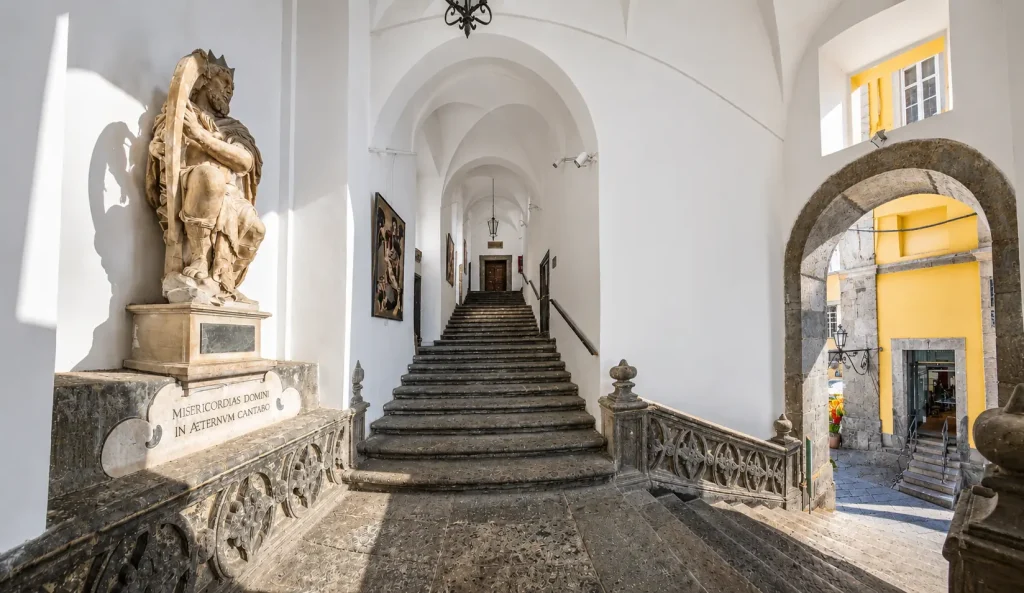
The elegant interior of Pio Monte della Misericordia leads visitors toward one of Naples’ greatest hidden artistic treasures — Caravaggio’s masterpiece “The Seven Works of Mercy.”
Most visitors come to Naples for pizza, Pompeii, or the city’s dramatic coastline. Yet hidden along the bustling Via dei Tribunali stands one of the most extraordinary artistic treasures in Italy — Pio Monte della Misericordia, often overlooked even by travelers who consider themselves art lovers.
If you’re wondering where to see Caravaggio in Naples, this is the single most important stop. While several museums across the city display works connected to the artist and his followers, Pio Monte della Misericordia houses the masterpiece most closely associated with his Neapolitan period. This historic church and charitable institution houses Caravaggio’s greatest Neapolitan masterpiece, The Seven Works of Mercy (Le Sette Opere della Misericordia), a monumental painting that many art historians consider one of the most ambitious works of the Italian Baroque period.
Unlike famous masterpieces that travel between global museums and international exhibitions, this painting has never left its original home. To see it, visitors must come to Naples itself and stand beneath the very altar for which it was created more than four centuries ago.
If you thought the mysteries of the Sansevero Chapel or the underground depths of the Catacombs of San Gennaro were impressive, wait until you step inside Pio Monte della Misericordia.
The Story of Pio Monte della Misericordia: Seven Men and a Mission
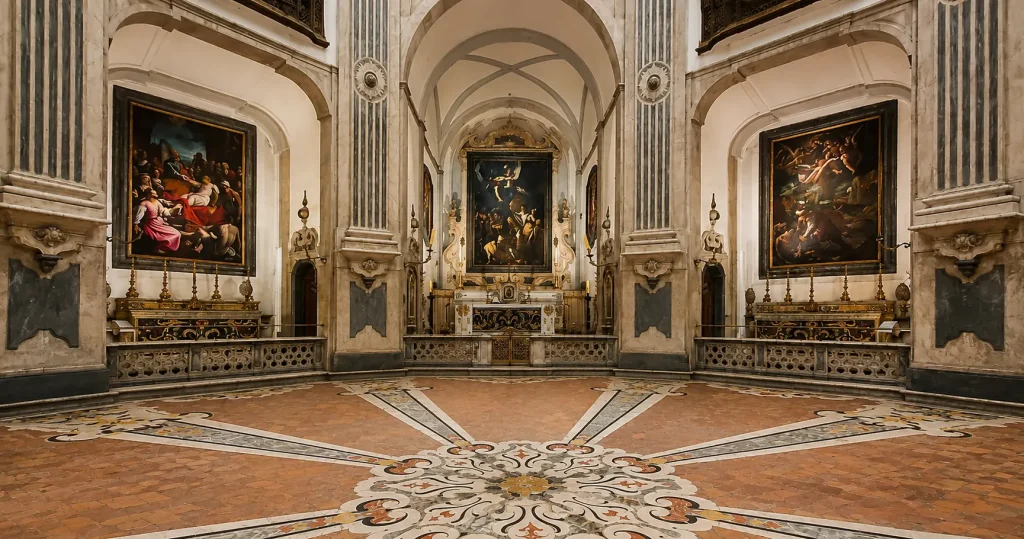
The historic interior of Pio Monte della Misericordia, home to Caravaggio’s famous The Seven Works of Mercy in Naples, Italy.
A Brotherhood of Mercy in the Heart of Naples
The story begins in 1601, during the Spanish Viceroyalty of Naples. At the time, Naples was one of the largest and most chaotic cities in Europe. Behind its immense wealth and grand palaces, however, thousands of residents lived in extreme poverty. Disease, hunger, and overcrowding were constant realities.
In response, seven young Neapolitan noblemen formed a charitable brotherhood dedicated to helping the city’s most vulnerable citizens. Their goal was simple yet revolutionary: to demonstrate that aristocratic privilege should be accompanied by social responsibility. What began as a small charitable organization quickly grew into one of Naples’ most respected institutions.
The brotherhood focused on what Christianity calls the “Seven Works of Mercy”:
Feeding the hungry
Giving drink to the thirsty
Clothing the naked
Sheltering pilgrims
Visiting the sick
Visiting prisoners
Burying the dead
These principles continue to guide the institution today. More than 400 years later, Pio Monte della Misericordia remains active as a charitable foundation, making it one of the oldest continuously operating philanthropic organizations in Europe.
The Church That Refused to Sell Its Art
One of the most remarkable aspects of Pio Monte della Misericordia is its unwavering commitment to preserving Caravaggio’s masterpiece. Shortly after commissioning The Seven Works of Mercy in 1607, the brotherhood established strict, legally binding rules concerning the painting: the work could never be sold, removed, gifted, or permanently relocated.
Over the centuries, wealthy private collectors, foreign governments, and major international museums have expressed interest in buying or borrowing the masterpiece. The answer from the brotherhood has always been a fierce “No.”
As a result, this world-famous work remains exactly where Caravaggio intended it to be — hanging directly above the high altar of the church. For art lovers, this creates a rare opportunity. Unlike many masterpieces displayed in sterile museum environments, The Seven Works of Mercy can still be experienced within its original architectural, historical, and spiritual setting.
Decoding Caravaggio’s “The Seven Works of Mercy”
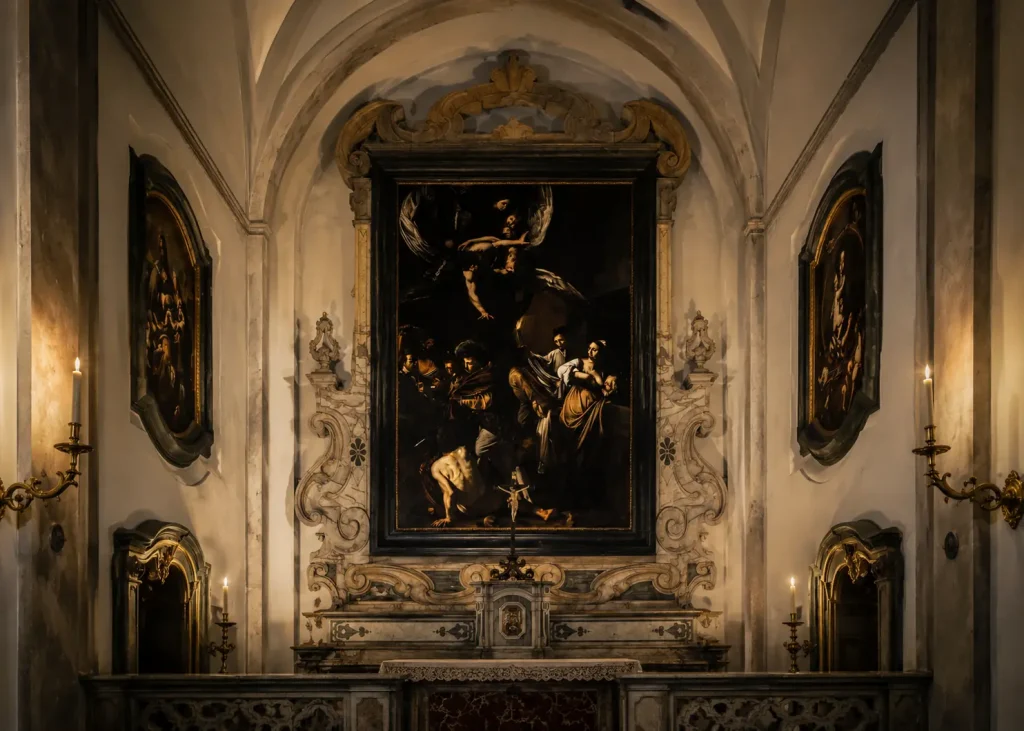
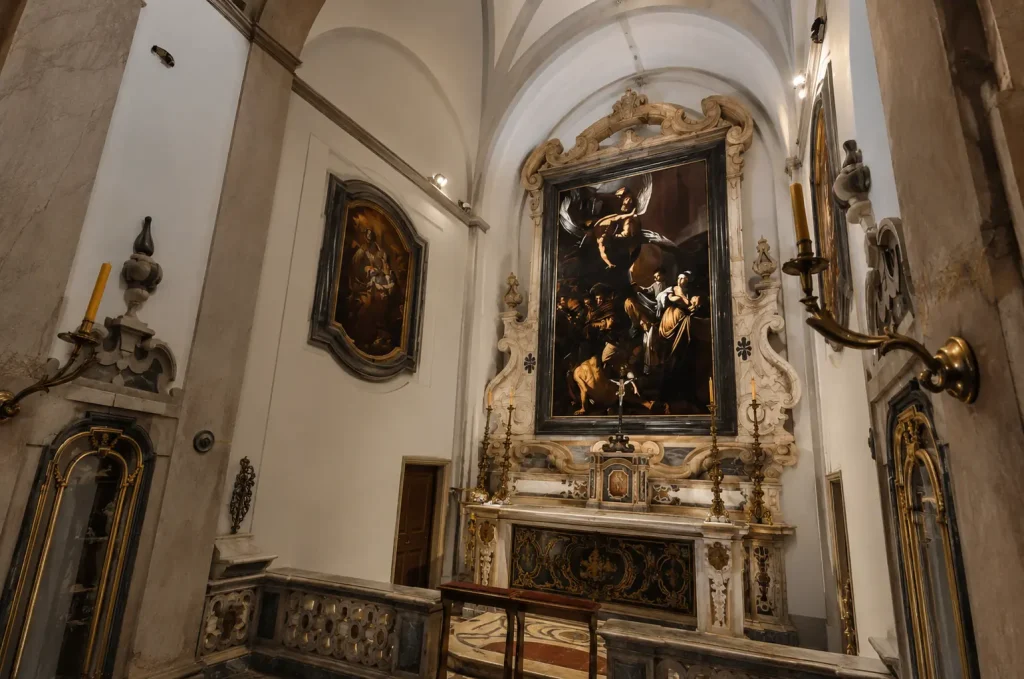
Caravaggio’s masterpiece The Seven Works of Mercy remains in its original location above the high altar of Pio Monte della Misericordia in Naples.
A Masterpiece Born in Exile
Few paintings carry such a dramatic personal history. When Caravaggio arrived in Naples in 1606, he was a desperate fugitive. After killing a man during a violent street altercation in Rome, the brilliant artist had fled the city with a papal death sentence hanging over his head. He arrived in Naples seeking protection, work, and perhaps redemption.
The city welcomed him with open arms. Within months, Naples’ high aristocracy and influential religious institutions were actively competing to secure commissions from the already famous painter. The commission from Pio Monte della Misericordia became the most important of these early Neapolitan projects.
Many scholars believe the painting directly reflects Caravaggio’s own fractured emotional state. Surrounded by themes of mercy, forgiveness, charity, and salvation, the work can be interpreted as both a religious masterpiece and a deeply personal plea for grace from a man running for his life.
Chiaroscuro and Street Reality
At first glance, the painting appears beautifully chaotic. Dark figures emerge from deep shadows, bodies overlap dynamically, and multiple events unfold simultaneously. Yet this apparent disorder hides extraordinary artistic control. Rather than creating seven separate panels, Caravaggio combined all seven acts of mercy into a single crowded, nocturnal Neapolitan street scene.
His signature technique — chiaroscuro — floods the composition with dramatic, theatrical contrasts between piercing light and absolute darkness. Even more revolutionary was his choice of models. Instead of idealized saints and airbrushed angels, Caravaggio used ordinary people as his inspiration. Contemporary accounts suggest he observed laborers, merchants, beggars, and prostitutes from the surrounding dark alleys of Naples. For seventeenth-century viewers, the message was clear: mercy was not something that belonged to distant saints. It belonged to the rugged streets of Naples itself.
Hidden Details You Might Miss
The longer you study the painting, the more fascinating details emerge from the shadows:
The Daughter Feeding Her Imprisoned Father: One of the most famous scenes depicts a young woman secretly breastfeeding an elderly prisoner through prison bars. This shocking image illustrates the ancient Roman story of “Roman Charity” (Caritas Romana), in which a daughter saves her starving father from execution. It masterfully combines two acts of mercy: visiting prisoners and feeding the hungry.
Samson and the Miracle of Water: Look carefully near the lower-left section of the composition. A man drinks water flowing from the jawbone of a donkey — a direct reference to the biblical story of Samson, who was miraculously provided water after battle. This small detail represents giving drink to the thirsty.
The Angels Above the Chaos: Many visitors focus exclusively on the crowded street scene below. However, the painting’s upper section contains a chaotic, almost sensual heavenly vision of the Madonna and Child surrounded by angels with dynamically tangled wings. Their presence transforms ordinary street life into a spiritual drama, linking earthly actions directly to divine mercy.
Why This Painting Changed Naples Forever
The impact of The Seven Works of Mercy went far beyond the walls of Pio Monte. The unveiling of the painting sent shockwaves through the local art community. Before Caravaggio’s arrival, Neapolitan art was dominated by conservative, idealized Mannerism.
Following the massive success of this masterpiece, dozens of local and visiting artists began aggressively copying Caravaggio’s raw realism and dramatic use of shadow. This artistic revolution effectively gave birth to the 17th-century Neapolitan School of Painting, forever shifting the trajectory of southern Italian art.
Rare Legends & Lesser-Known Facts about Pio Monte
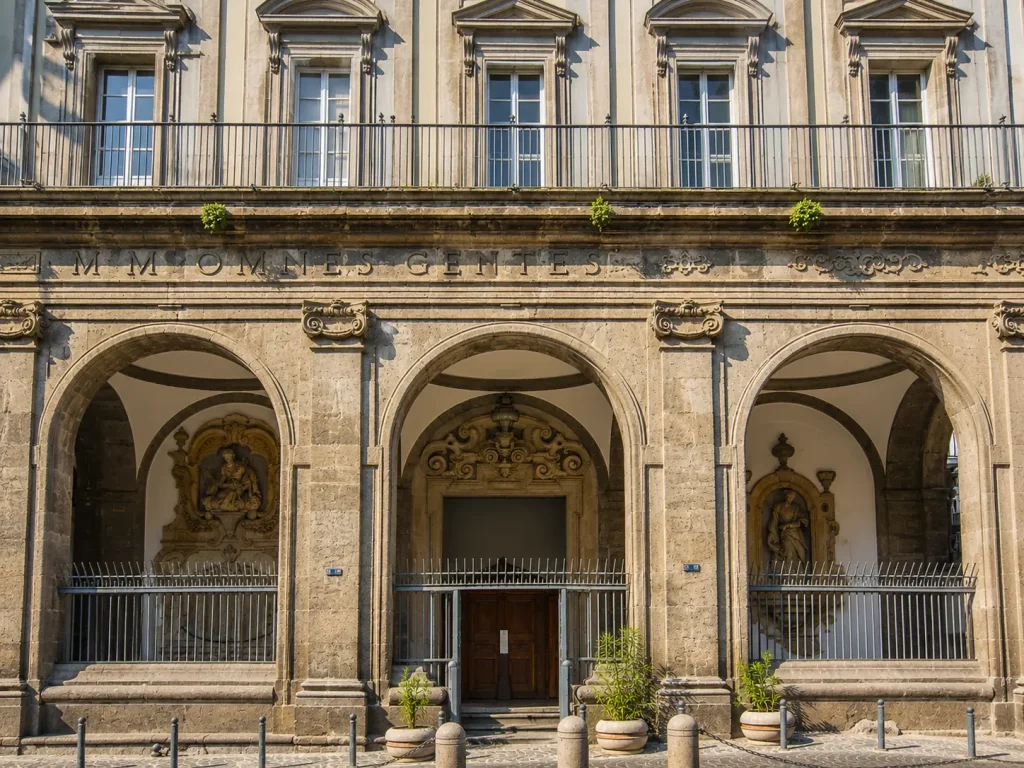
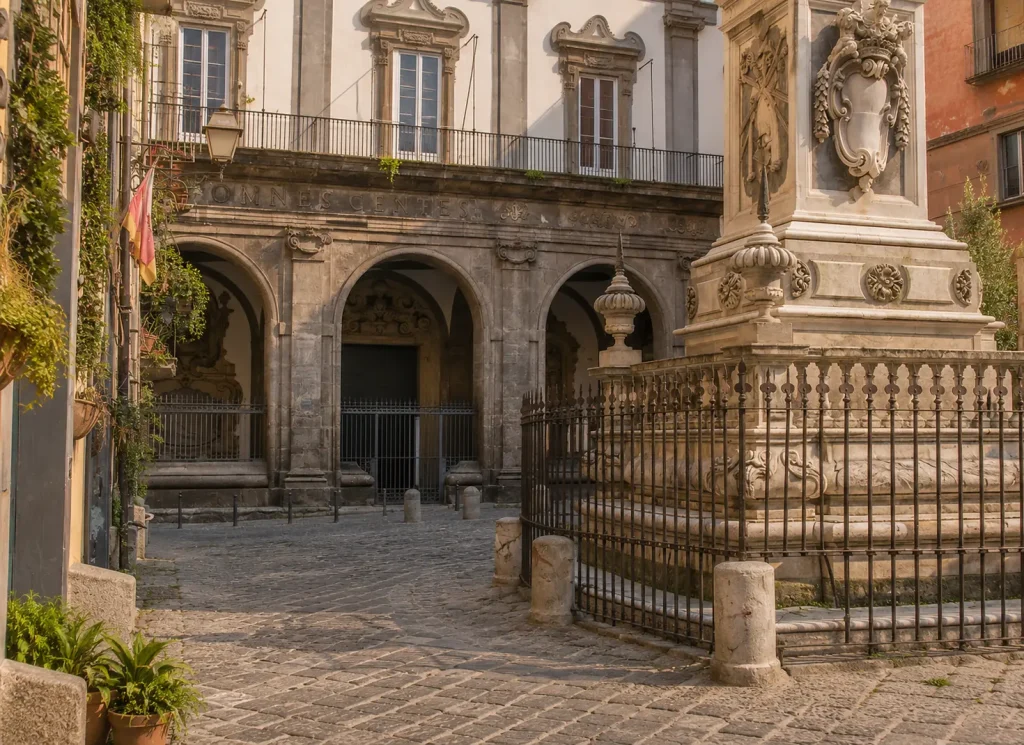
The historic facade of Pio Monte della Misericordia on Via dei Tribunali, home to Caravaggio’s masterpiece The Seven Works of Mercy.
The Painting That Saved Caravaggio’s Life
The brotherhood reportedly paid Caravaggio approximately 400 ducats for the commission — a truly astronomical sum at the time. For a man living in exile and constant uncertainty, this payment provided much more than financial stability; it completely restored his reputation.
Receiving such a prestigious commission signaled to the rest of Italy that Caravaggio remained one of Europe’s greatest living artists, despite his criminal status. Some historians believe this specific commission played a crucial role in protecting him from political and legal threats during his years on the run, giving him the elite backing he needed to survive.
Caravaggio Painted It in Just a Few Months
Unlike many large church commissions that took years of meticulous planning and slow execution to complete, Caravaggio finished The Seven Works of Mercy remarkably quickly. Contemporary records suggest he completed the enormous, highly detailed altarpiece within only a few months. The incredible speed shocked his patrons and further fueled his reputation as both an unpredictable outsider and an undeniable, lightning-fast genius.
The Hidden Modern Art Collection
Many tourists visit solely for the Caravaggio and leave without exploring the upper floors. That is a massive mistake. The institution’s Quadreria (art gallery) contains works spanning centuries, including pieces by important Neapolitan masters like Jusepe de Ribera and Luca Giordano.
Even more surprising is the museum’s modern collection, created through an ongoing dialogue with Caravaggio’s legacy. Visitors can encounter cutting-edge contemporary works by major global artists, including Joseph Beuys, Anish Kapoor, and Francesco Clemente. This unusual combination of dark Baroque and minimalist contemporary art makes Pio Monte unlike any other museum in Naples.
The Ghostly Signatures
Local folklore has surrounded the church for centuries. One of the most persistent legends claims that Caravaggio’s restless spirit still visits the building after dark. According to the tale, staff and guards occasionally notice strange, shifting shadows near the high altar, particularly during quiet afternoons when the natural sunlight enters through the upper windows. The legend says the painter returns to ensure that the changing light still strikes his masterpiece exactly as he intended it to over 400 years ago.
Practical Guide for Visitors
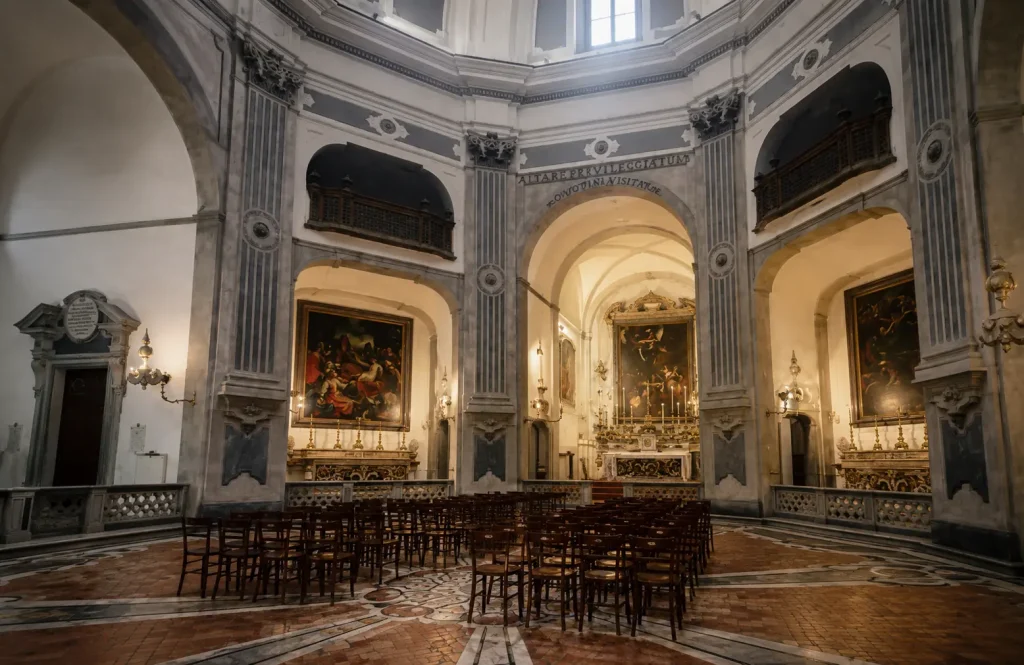
The elegant Baroque interior of Pio Monte della Misericordia in Naples, where Caravaggio’s masterpiece The Seven Works of Mercy remains in its original setting.
Unlike many world-class art museums, Pio Monte offers an intimate experience where you can enjoy fine art without the overwhelming tourist crowds.
Visitor Detail
Essential Information
Address
Via dei Tribunali 253, 80139 Naples, Italy
Location
Historic Center (Centro Storico), near the Duomo
Opening Hours
Monday – Saturday: 10:00 AM – 6:00 PM
Sunday Hours
9:00 AM – 2:30 PM
Ticket Price
Around €10 (Reduced tickets available for students/seniors)
The Seven Works of Mercy, The Quadreria, Modern Art Collection
Insider Tips for Art Lovers
Tip #1: Use the Audio Guide: Many visitors underestimate the complexity of Caravaggio’s composition. Taking advantage of the audio guide or QR-based digital guide dramatically improves the experience by explaining the hidden symbolism and identifying each intertwined act of mercy.
Tip #2: View the Painting from Above: Most people only admire the masterpiece from the church floor. However, your ticket grants you access to upper-level viewing points inside the Quadreria. Historically, elite members of the brotherhood used these shuttered palace windows to attend religious services discreetly. From these elevated vantage points, the painting’s composition reveals incredible details that are impossible to appreciate from below.
How to Get to Pio Monte della Misericordia
A peaceful view of Piazza Riario Sforza and the historic facade of Pio Monte della Misericordia in the heart of Naples’ Centro Storico.
By Metro
The easiest route is via Naples Metro Line 1. You can exit at any of the following stations:
Duomo Station (Closest option, about a 5-minute walk)
Museo Station (About a 12-minute walk)
Cavour Station (Metro Line 2, about a 10-minute walk)
From any of these stops, the walk to the church takes you straight through the historic center. Walking along Via dei Tribunali is an attraction in itself, passing chaotic scooter traffic, historic palaces, old-school bakeries, and some of Naples’ most authentic street life.
Combine Your Visit: A Perfect Day in Historic Naples
Pio Monte della Misericordia occupies an ideal position for exploring the heart of the Centro Storico. Within a short walk, you can easily combine your visit with:
Naples Cathedral (Duomo di Napoli) and the San Gennaro Treasure Museum (3 mins away)
The famous Sansevero Chapel (7 mins away)
Via San Gregorio Armeno (The famous Christmas Alley, 5 mins away)
Naples Underground / Napoli Sotterranea (6 mins away)
Together, these sites create one of the most rewarding and dense cultural itineraries in southern Italy.
Why Pio Monte is a Must-Visit for Every Traveler
A closer perspective of Caravaggio’s The Seven Works of Mercy in its original chapel setting at Pio Monte della Misericordia, Naples.
Many travelers search for hidden gems in Naples and never realize that one of the world’s greatest artistic achievements sits quietly behind an unassuming Baroque façade.
Pio Monte della Misericordia offers something increasingly rare in modern tourism: absolute authenticity. Here, visitors encounter a masterpiece exactly where it was born to be seen. They discover a charitable institution that is still actively fulfilling its original mission after four centuries. Most of all, they explore a sanctuary where art, faith, history, and legend continue to coexist seamlessly.
Few places in Italy combine world-class art, living history, and centuries of charitable tradition as powerfully as Pio Monte della Misericordia. It is a unique place where history, faith, charity, legend, and artistic genius collide in a way found nowhere else in Naples.
FAQ
Can you take photos inside Pio Monte della Misericordia?
Yes. Non-flash photography is permitted for personal use throughout the church and upper museum galleries.
Is Pio Monte della Misericordia wheelchair accessible?
Partially. The main church floor and the altar area are fully accessible. The upper levels housing the Quadreria can be reached via an on-site elevator.
How much time do I need for the visit?
Most visitors spend between one and one-and-a-half hours exploring the ground-floor church, the historic gallery, and the contemporary art spaces.
Do I need to book tickets in advance?
Unlike the incredibly popular Sansevero Chapel (Veiled Christ), tickets for Pio Monte are often readily available on-site. However, during the peak summer tourist season (May–September), booking online in advance is recommended to secure your preferred time slot.
Can you visit Pio Monte during a mass?
Pio Monte is primarily operated as a museum and cultural site today, though special religious services are still held occasionally. Check their official calendar if you wish to avoid or attend specific institutional events.