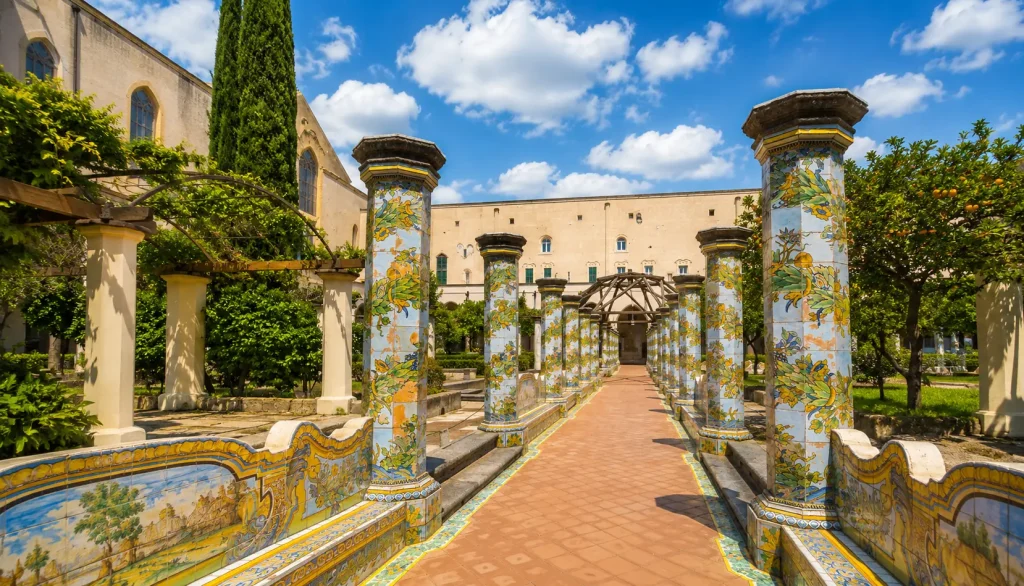
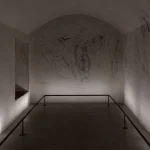
The colorful majolica columns of the Cloister of Santa Chiara create one of the most peaceful and beautiful hidden spaces in Naples.
Naples is famous for its energy, noise, and beautiful chaos. Along the bustling streets of Spaccanapoli, scooters weave through crowds, street vendors call out to passersby, and church bells echo between centuries-old buildings.
Then something unexpected happens.
You step through an unassuming entrance in the heart of the historic center and suddenly find yourself surrounded by silence. The scent of orange and lemon trees fills the air. Colorful ceramic columns sparkle under the Mediterranean sun. Birds replace traffic noise.
Welcome to the Cloister of Santa Chiara (Chiostro di Santa Chiara), one of Naples’ most beautiful hidden treasures.
More than just a monastery courtyard, Santa Chiara is a masterpiece of art, architecture, and symbolism—a peaceful refuge that reveals an entirely different side of Naples. In this guide, you’ll discover the history of this remarkable place, learn the hidden meanings behind its famous majolica tiles, and find everything you need to plan the perfect visit
A Dual Legacy: From Austere Gothic to Baroque Sunshine
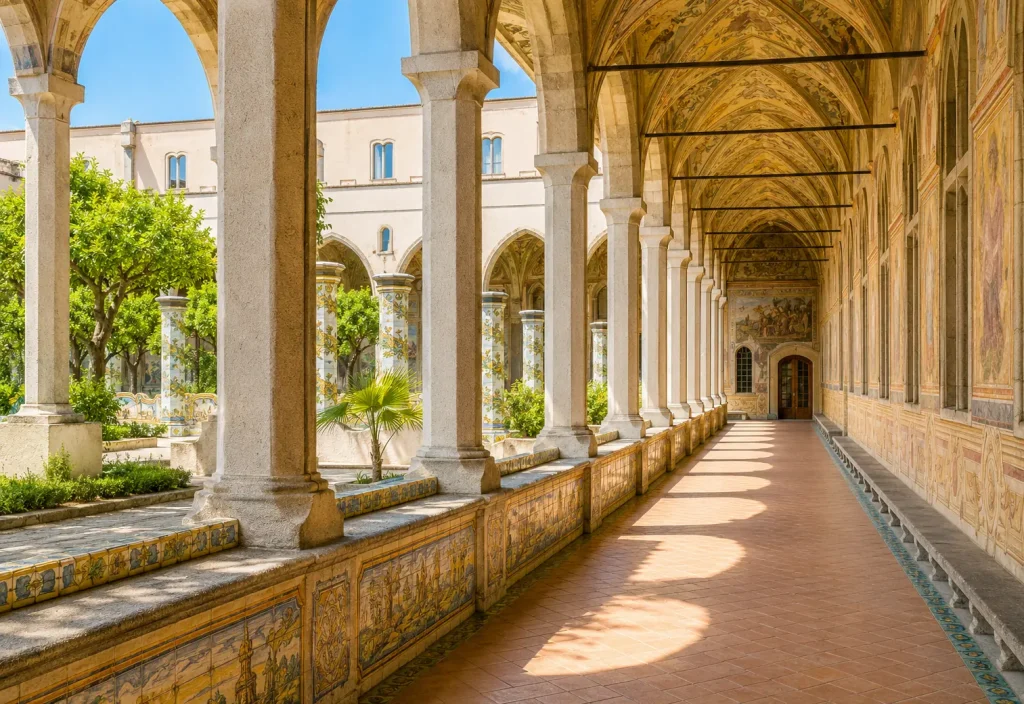
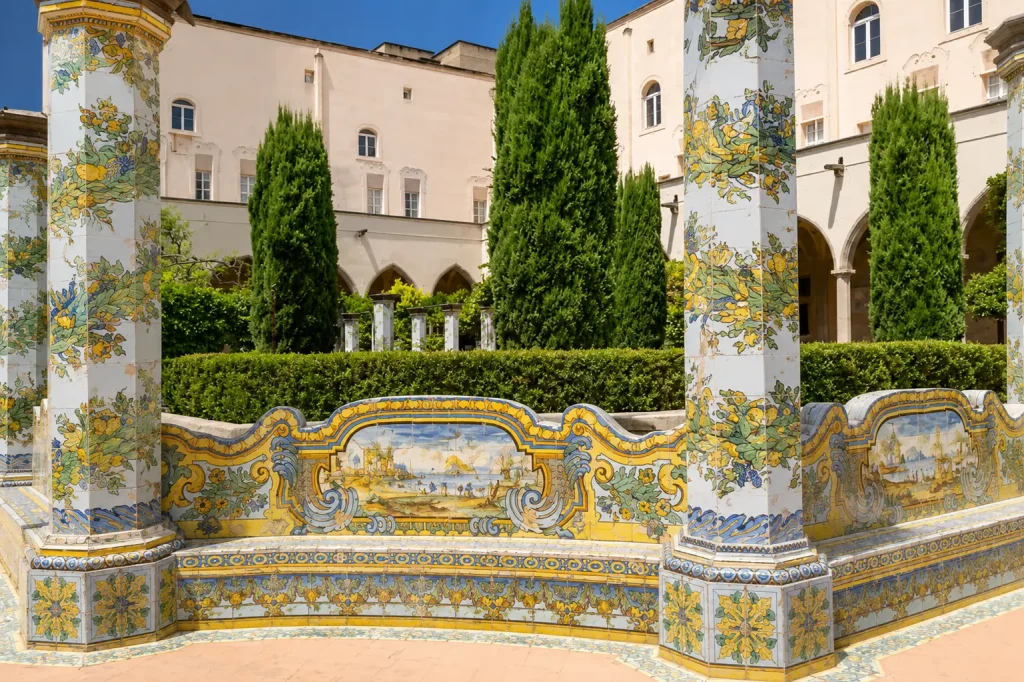
The peaceful arcades of the Cloister of Santa Chiara offer a striking contrast to the busy streets of Naples, combining Gothic architecture, colorful majolica decorations, and tranquil garden views.
The Angevin Foundations (14th Century)
The story of Santa Chiara begins in 1310 when King Robert of Anjou and Queen Sancia of Majorca commissioned one of the largest religious complexes in medieval southern Italy.
Built for the Franciscan Poor Clares, the monastery reflected the ideals of humility, contemplation, and simplicity. The original cloister was intentionally austere, designed to encourage spiritual reflection rather than worldly distraction.
The adjoining basilica quickly became one of the most important churches in Naples and served as the burial place of Angevin royalty and nobles.
For centuries, the complex remained a center of religious life in the heart of the city.
The 18th-Century Transformation
Everything changed in the 1740s.
By then, Naples had become one of Europe’s largest and most sophisticated cities. Tastes had shifted from medieval austerity toward the elegance and theatricality of the Baroque era.
In 1742, architect Domenico Antonio Vaccaro was commissioned to redesign the cloister. Supported by Queen Maria Amalia of Saxony, Vaccaro transformed the severe monastery courtyard into a vibrant Mediterranean garden.
He introduced pergolas, citrus groves, flower beds, winding paths, and the famous octagonal columns and benches covered in brightly painted majolica.
The result was unlike any monastery courtyard in Italy—a harmonious blend of architecture, nature, and ceramic art that still captivates visitors nearly three centuries later.
Rising From the Ashes of World War II
One of the most dramatic chapters in Santa Chiara’s history occurred during World War II.
In August 1943, Allied bombing raids struck Naples. The Basilica of Santa Chiara suffered devastating damage, and much of its elaborate Baroque interior was destroyed by fire.
Miraculously, the cloister survived.
Many Neapolitans still consider the survival of the majolica garden almost miraculous. While much of the church’s interior was lost, the delicate ceramic decorations escaped destruction. Today, visitors can admire one of the few major decorative ensembles from Bourbon-era Naples that survived the war largely intact.
After the conflict, restoration experts made a remarkable decision. Rather than rebuilding the basilica in its Baroque form, they restored it to its original medieval Gothic appearance.
The result is a fascinating contrast: a solemn Gothic church standing beside one of the most colorful Baroque gardens in Europe.
Deciphering the Majolica Tiles: Stories Frozen in Ceramic
The Mastery of Donato and Giuseppe Massa
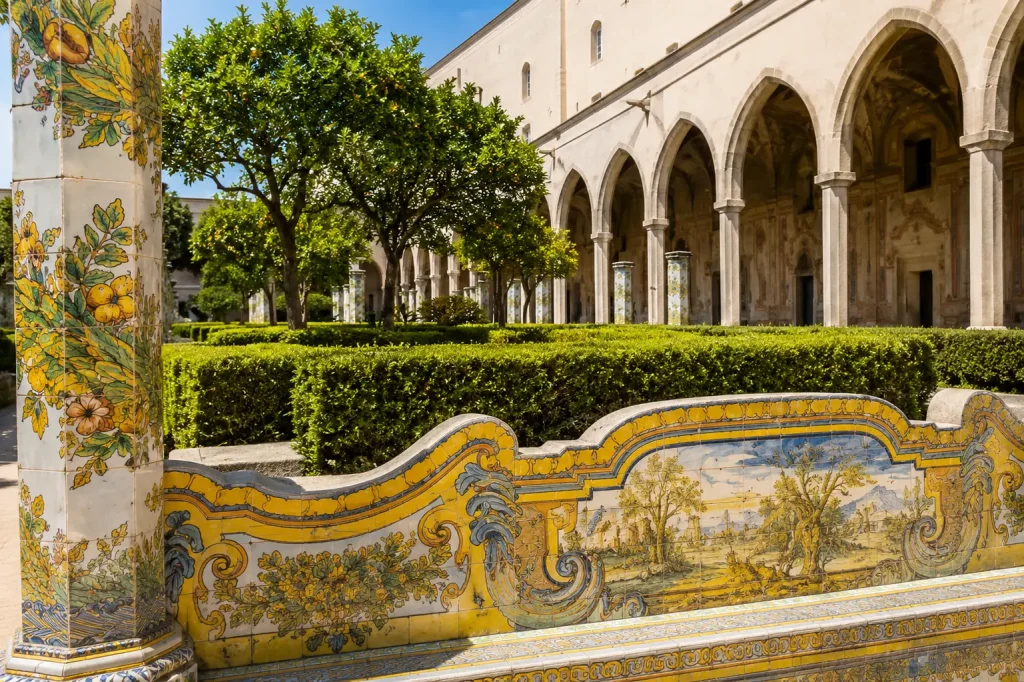
The famous majolica benches of the Cloister of Santa Chiara combine vibrant ceramic artwork, Mediterranean gardens, and historic monastery architecture in the heart of Naples.
The magnificent ceramic decorations were created by Donato and Giuseppe Massa, master craftsmen from one of Naples’ most respected ceramic families.
The hand-painted tiles, known locally as riggiole, were individually crafted and fired using traditional techniques that had been perfected over generations.
If you look closely, you’ll notice subtle variations between individual tiles—small details that reveal the human hand behind every piece.
Together, the Massa brothers created one of the most celebrated examples of majolica art in Italy.
Worldly Scenes in a Sacred Place
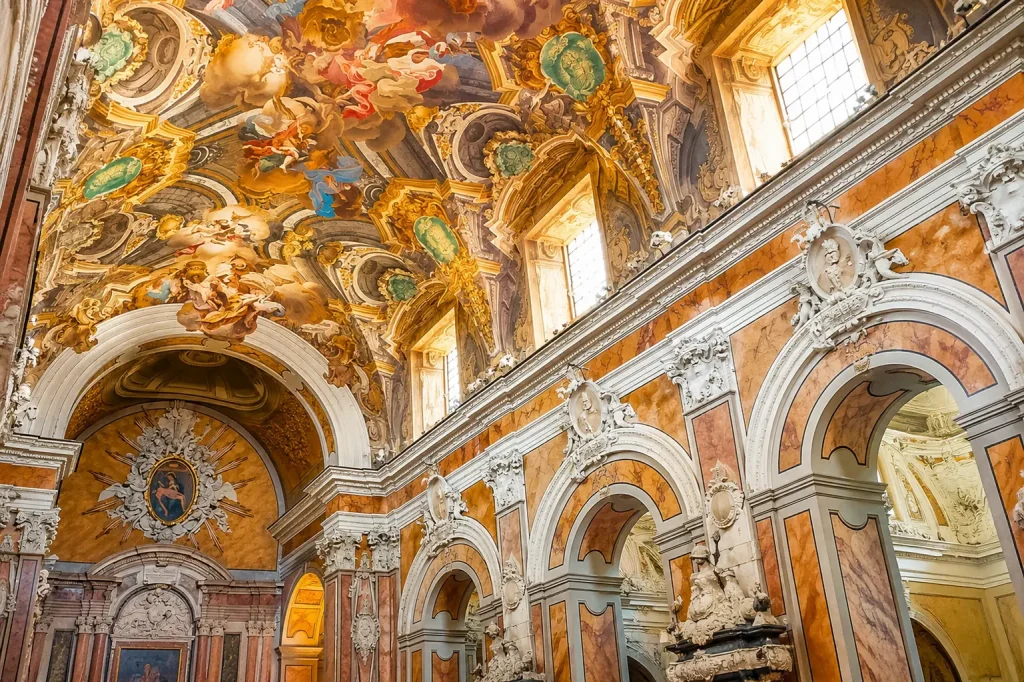
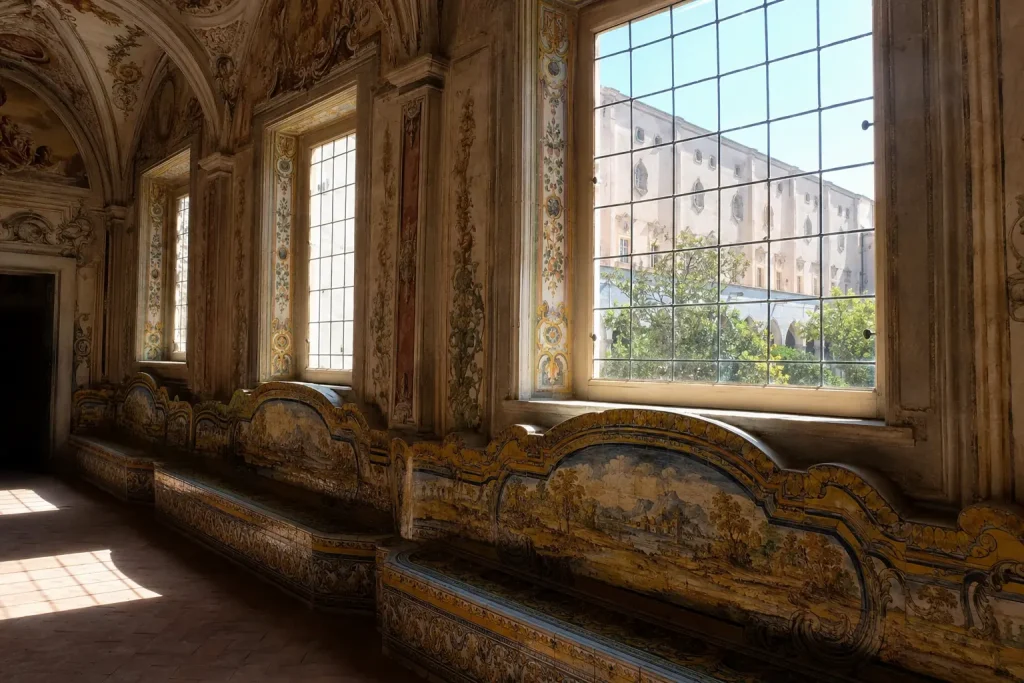
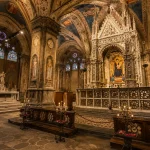
The historic Baroque interior of Santa Chiara showcases elaborate ceiling frescoes, marble details, and artistic masterpieces that once decorated one of Naples’ most important religious complexes.
One of the cloister’s greatest surprises is its imagery.
Unlike most religious settings, the decorations here are not dominated by saints or biblical stories. Instead, the tiles depict scenes from everyday life in 18th-century Naples.
Visitors can spot fishermen hauling their catch, farmers harvesting crops, noble hunting parties, carnival celebrations, rural landscapes, and even mythological figures.
The famous Pulcinella, the iconic character of Neapolitan folklore, also appears among the scenes.
Historians believe these images were intentionally chosen to bring the outside world into the enclosed lives of the nuns. Since the Poor Clares rarely left the monastery, the painted tiles served as windows into the vibrant society beyond the walls.
The 18th-Century Cat Hunt
As you wander between the benches, look out for a playful detail left by the Massa brothers.
Among the rural scenes, visitors can spot a cat sneakily stealing a fish. Cats have long been part of monastic life in Naples, and even today a few resident felines can often be seen lounging around the cloister garden.
See if you can spot both the ceramic cat and a real one during your visit.
Color Psychology for Cloistered Nuns
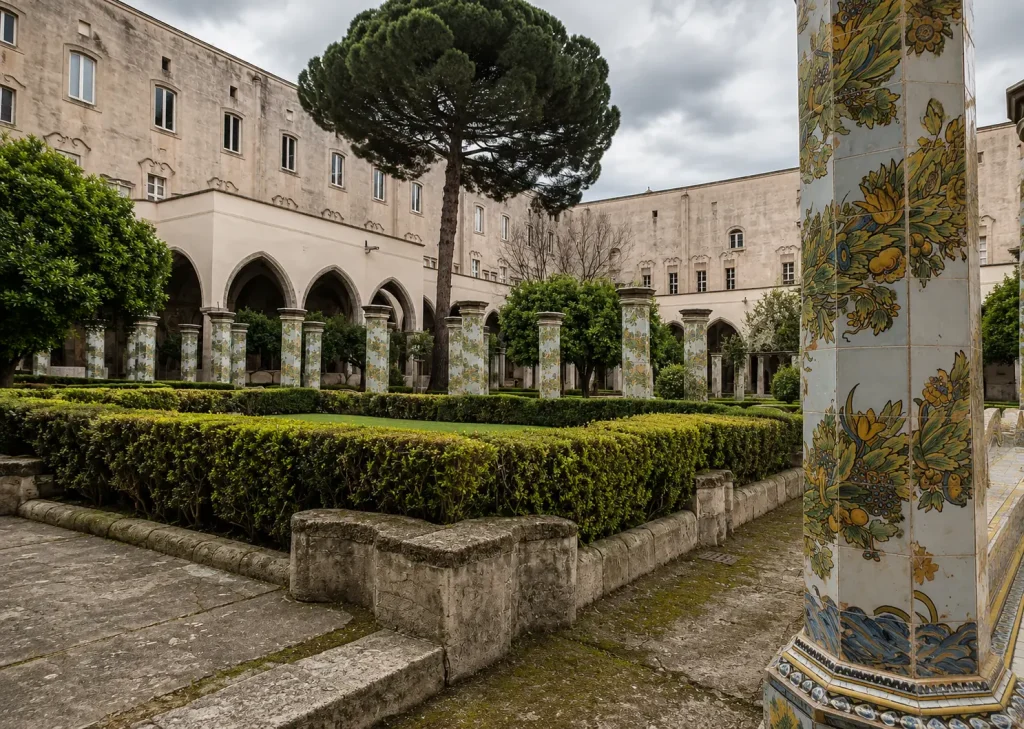
The famous majolica benches and columns of the Cloister of Santa Chiara showcase some of the finest ceramic artistry in Naples, with vibrant 18th-century scenes painted by the Massa workshop.
Perhaps the most fascinating theory surrounding the cloister concerns its colors.
Many young women entered convents not entirely by choice. Noble families often placed daughters in monasteries for social or financial reasons, leaving them largely separated from the outside world.
For these women, life behind monastery walls could be isolating.
Vaccaro’s garden may have been designed as a remedy against melancholy. The brilliant yellows evoke sunlight. The deep blues recall the Bay of Naples. Orange and lemon groves provide fragrance and seasonal change, while flowering wisteria adds bursts of color throughout the year.
Together, these elements created a carefully designed sensory experience that connected the nuns with the beauty of the outside world.
A Crucial Visitor Etiquette Note
While the brilliant yellow and blue majolica benches look incredibly inviting, you are strictly forbidden to sit on them.
These 300-year-old ceramic masterpieces are highly fragile and carefully protected. Keep your eyes open for the designated modern benches if you need a rest, and keep your camera ready to capture the artwork from a respectful distance.
Secret Windows to the Outside World
The upper galleries of Santa Chiara offered enclosed nuns a rare connection to the outside world, allowing them to observe life beyond the monastery while remaining hidden from public view.
Life inside the convent was strictly enclosed, yet complete isolation was neither practical nor desirable.
Historians believe portions of the upper galleries and terraces were designed to allow the Poor Clares to observe major religious processions passing through nearby Spaccanapoli without being seen themselves.
Through small openings and screened viewpoints, the nuns could maintain a symbolic connection with the city beyond the monastery walls while preserving the rules of enclosure.
For women who might spend decades within the convent, these hidden vantage points offered rare glimpses of Naples’ vibrant public life.
Beyond the Garden: Hidden Treasures of the Complex
Beyond its famous majolica courtyard, the Santa Chiara complex hides centuries of history, including archaeological remains, museum collections, and secluded monastery spaces rarely noticed by visitors.
Many visitors come solely for the famous courtyard and leave without exploring the rest of the complex.
That would be a mistake.
The Ancient Roman Baths
Beneath parts of the monastery lie the remains of ancient Roman thermal baths dating to the 1st century AD.
These archaeological remains are among the largest bath complexes discovered in ancient Naples and provide a fascinating reminder that the city has been continuously inhabited for more than two thousand years.
Walking through Santa Chiara means moving through multiple layers of history—from Roman Naples to medieval kingdoms and modern Italy.
The Convent Museum (Museo dell’Opera)
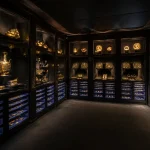
The museum preserves sculptures, tomb fragments, religious artifacts, and architectural elements that survived the destruction of World War II.
Among the highlights are medieval carvings, Angevin-era relics, and objects recovered during the restoration of the basilica.
The collection offers valuable context for understanding the history of the entire complex.
The Neapolitan Presepe
One of the museum’s most beloved attractions is its traditional 18th-century Neapolitan nativity scene.
Far more than a simple Christmas display, it recreates entire streets of historic Naples filled with merchants, musicians, bakers, fishermen, aristocrats, and ordinary citizens.
The incredible craftsmanship makes it one of the finest examples of the Neapolitan presepe tradition.
Practical Visitor Guide
Visitor Detail
Essential Information
Address
Via Santa Chiara, 49/c, 80134 Naples, Italy
Closest Metro
Line 1 — Università or Dante (5-minute walk)
Opening Hours
Mon–Sat: 9:30 AM – 5:30 PM
Sunday Hours
10:00 AM – 2:30 PM (Last entry 30 mins before closing)
Ticket Prices (2026)
€6 Full / €4.50 Reduced (Students under 26 & Seniors 65+)
Visit Duration
45–60 minutes
Photography Tip
For the best photographs, arrive either right at opening time or during the final hour before closing.
The morning offers the quietest atmosphere, while late afternoon light beautifully enhances the texture and colors of the majolica tiles. These periods also tend to have the fewest visitors.
The Ultimate Spaccanapoli Walking Route
The Bay of Naples glows beneath a dramatic Mediterranean sunset, with illuminated streets, marinas, and coastal neighborhoods stretching along the shoreline.
One of the best ways to experience Naples is to connect several of the city’s hidden treasures into a single day of exploration.
Morning
Begin at the Capodimonte Museum, home to one of Italy’s finest collections of Renaissance and Baroque art.
Afterward, head toward the Catacombs of San Gennaro, where early Christian Naples lies hidden beneath the city streets.
Midday
Continue through the vibrant Rione Sanità district and stop at Palazzo dello Spagnolo, one of Naples’ most remarkable Baroque architectural masterpieces.
Take time to explore the surrounding streets, artisan workshops, and neighborhood cafés before continuing toward the historic center.
Afternoon
Arrive at Spaccanapoli and step into the Cloister of Santa Chiara.
After hours spent navigating the city’s lively streets, the silence of the citrus garden feels almost magical. It is the perfect place to slow down, recharge, and appreciate a calmer side of Naples that many visitors never discover.
Hidden Gems in Naples
Beyond the pizza shops, chaotic traffic, and famous waterfront views, Naples hides ancient underground cities, forgotten Roman theatres, secret tunnels, mysterious churches, hidden palaces, and candlelit passages buried beneath centuries of history. Here are the hidden gems that reveal the city’s most fascinating and authentic side.
Why Santa Chiara Remains One of Naples’ Most Photogenic Hidden Gems
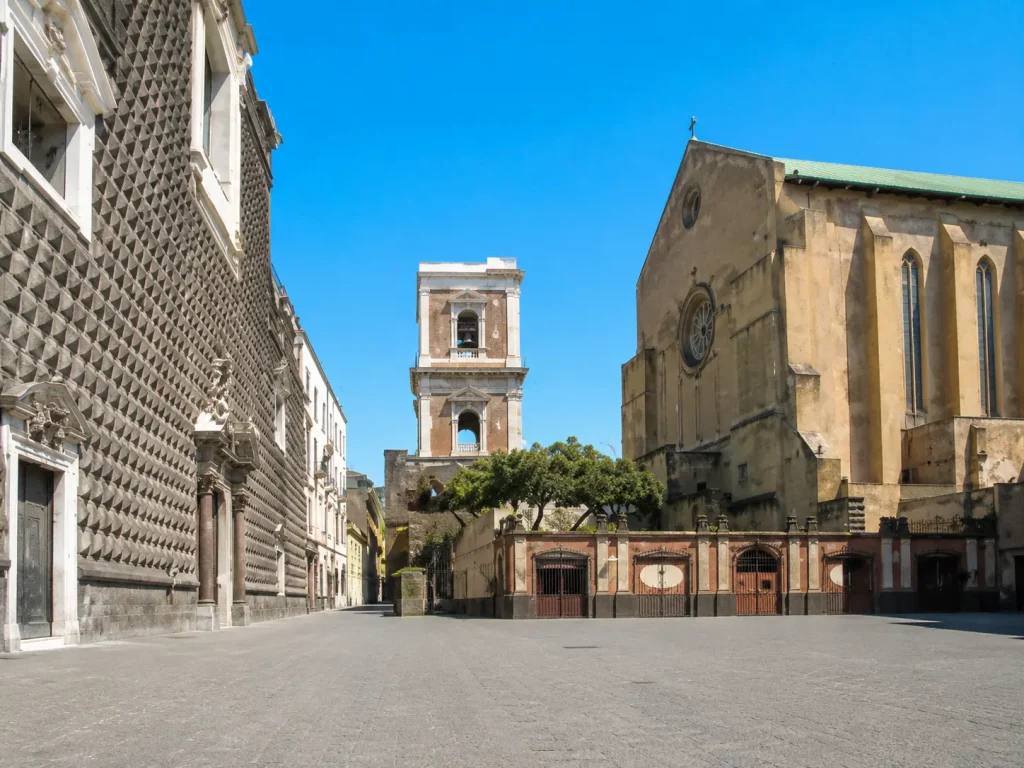
The Basilica of Santa Chiara rises above one of Naples’ most historic squares, creating a striking contrast between Gothic religious architecture and the city’s lively urban landscape.
In a city known for underground tunnels, dramatic castles, bustling piazzas, and vibrant street life, the Cloister of Santa Chiara offers something completely different.
The combination of citrus groves, hand-painted majolica tiles, Baroque elegance, and centuries of history creates one of the most photogenic and peaceful locations in Naples.
Whether you’re a photographer searching for unique compositions, a history enthusiast exploring Naples’ layered past, or simply a traveler looking for a quiet escape from the crowds of Spaccanapoli, Santa Chiara remains one of the city’s most rewarding hidden gems.
FAQ
Can I visit the Basilica of Santa Chiara for free?
Yes. Entry to the basilica itself is generally free. Admission is required only for the cloister, museum, and archaeological areas.
How much time do I need for a visit?
Most visitors spend between 45 and 60 minutes exploring the cloister and museum. Photography enthusiasts may wish to stay longer.
Is the Cloister of Santa Chiara suitable for families?
Absolutely. Children often enjoy the colorful tile artwork, open courtyard spaces, and the many playful scenes depicted on the ceramics.
What is the best time of year to visit?
Spring is especially beautiful when the citrus trees are blooming and the garden is at its most colorful.
Is Santa Chiara one of Naples’ hidden gems?
Despite its central location, many tourists walk past without entering. For visitors seeking beauty, tranquility, history, and authentic local culture, it remains one of Naples’ most rewarding hidden gems.